How to Start a Business in 2026 With Less Money Than You Think (Step-by-Step Guide)
68% of aspiring entrepreneurs feel urgency to start in 2026 — but 47% think they can't afford it. Here's the truth: the real median startup cost is half what most people assume. A complete step-by-step guide to launching your business in 2026, with or without experience.
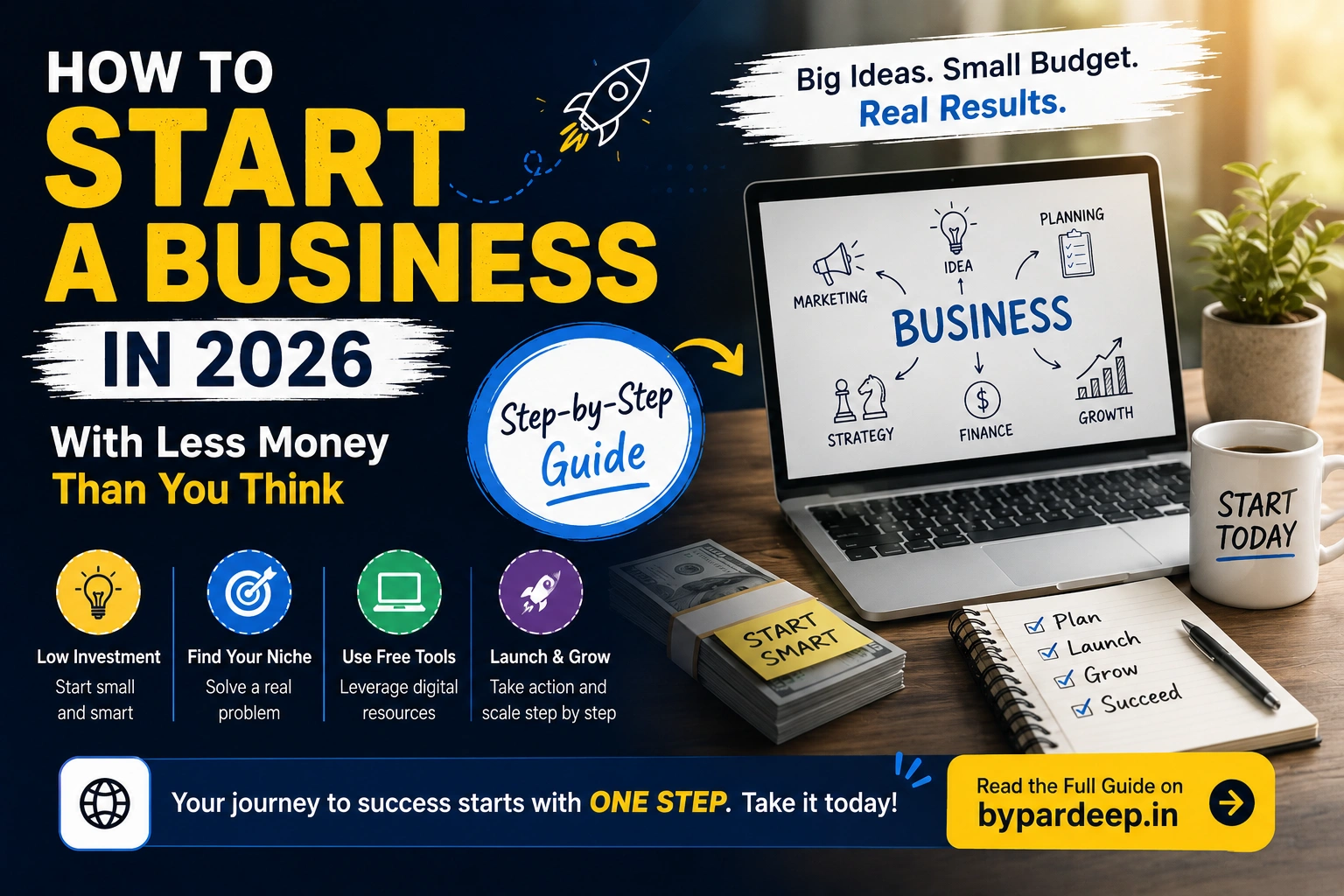
Here is a number that should stop you in your tracks: most people believe they need around $28,000 to start a business. The actual median startup cost? Just $12,000 — and for digital-first businesses in 2026, it can be far less than that.
According to a 2026 QuickBooks survey of over 3,000 adults, 68% of aspiring entrepreneurs feel urgency to start a business this year, and 57% say they will launch even if economic conditions are not ideal. Yet 47% cite cost as the number one reason they have not started yet — based on a number that is almost certainly wrong.
This guide is for you if you have been sitting on a business idea and telling yourself you are not ready, do not have enough money, or do not know where to start. By the end of this guide, you will have a clear, honest, step-by-step path from where you are right now to a real running business — using the tools, strategies, and realities of 2026.
The State of Entrepreneurship in 2026: Why Now Is the Best Time
The numbers paint a clear picture of where we are headed. One in three adults globally plans to start a new business or side hustle within the next 12 months — a 94% jump from last year. Gen Z leads in entrepreneurial intent at 43%, while Millennials feel the most urgency at 74%.
What has changed in 2026 that makes this different from any previous moment? Three things:
- AI has eliminated the cost of labour for early-stage businesses. Tasks that previously required hiring a writer, designer, data analyst, or developer can now be handled with AI tools for under $50/month combined.
- Digital-first distribution is available to anyone. You do not need a physical shop, a warehouse, or even a website to start selling. Social commerce, WhatsApp-based businesses, and platform storefronts make distribution free from Day 1.
- The "invisible entrepreneur" is now a real business model. QuickBooks data shows 47% of people earned money from a side hustle in the past year, yet only 1 in 5 registered their business. You can start, test, and earn before you formalise anything.
Step 1 — Find the Right Business Idea
The worst way to pick a business idea is to ask "what am I passionate about?" Passion does not pay bills. The better question is: "What problem do people around me pay to solve?"
The most successful businesses launched in 2026 are built around one of these four patterns:
| Pattern | What It Means | Example |
|---|---|---|
| Skill-as-a-Service | Sell a skill you already have as a service | Freelance content writing, video editing, social media management |
| Problem-as-a-Product | Build a product that fixes a frustration you experience | A niche software tool, a productivity app, a Chrome extension |
| Distribution Arbitrage | Buy or create something cheap and sell it to an audience willing to pay more | Reseller businesses, white-label SaaS, affiliate-based content sites |
| Audience Monetisation | Build an audience first, then monetise with products or ads | Blog, YouTube channel, newsletter, Pinterest traffic to AdSense |
Validation before building: Before spending a single rupee, validate demand. Post about your idea on social media. Ask five potential customers what they would pay. Create a simple landing page and measure interest. According to July 2026 startup trend analysis, the biggest reason new businesses fail is building something people do not actually need — not lack of funding or lack of skills.
Step 2 — Calculate Your Real Startup Cost
Most people wildly overestimate what it costs to start. Here is a realistic breakdown for a digital-first business in 2026:
| Expense | Cost (Approximate) | Free Alternative |
|---|---|---|
| Domain name | ₹800–1,500/year | Use a free subdomain initially |
| Website hosting | ₹200–500/month | Vercel, GitHub Pages (free) |
| AI writing tool | ₹700–1,700/month | ChatGPT or Claude free tier |
| Design tool | ₹0–1,300/month | Canva free tier |
| CRM / email tool | ₹0/month | HubSpot free forever |
| Business registration | ₹1,000–5,000 (one time) | Start unregistered, register when earning |
| Payment gateway | 2–3% per transaction | Razorpay, UPI (free to set up) |
| Realistic total (Month 1) | ₹3,000–8,000 |
A simple content business, freelance service, or digital product store can be launched in India for under ₹10,000. The ₹20–25 lakh figure people fear is for physical businesses with inventory, staff, and a shopfront. In 2026, that is not the only way.
Step 3 — Write a Simple One-Page Business Plan
You do not need a 40-page document. You need clear answers to five questions:
- Who is your customer? Be specific. Not "everyone" — a specific person with a specific problem.
- What problem do you solve for them? One sentence. If you need more than one sentence, the idea is not clear enough yet.
- How do you make money? What exactly does the customer pay for and how much?
- How do customers find you? SEO, WhatsApp, Instagram, referrals — pick one channel to start.
- What does success look like in 90 days? A specific number: 5 paying customers, ₹10,000 in revenue, 500 website visitors.
Write those five answers on a single page. That is your business plan. You can add complexity later once you are earning.
Step 4 — Set Up Your Business Infrastructure (In One Day)
The minimum you need to start operating in 2026:
- A way to be found: A website, a social media profile, or a WhatsApp Business account. Pick one to start.
- A way to communicate: A business email address (Google Workspace starts at ₹125/month, or use a free Gmail for the first few months).
- A way to get paid: Razorpay or a UPI QR code. Both are free to set up and take minutes.
- A way to deliver: Whatever your product or service actually is — a Google Drive folder, a WhatsApp message, a Zoom call, a physical delivery. Define this before your first customer arrives.
That is it. Many successful Indian entrepreneurs started with nothing more than a WhatsApp Business number, a Canva-designed PDF portfolio, and a Razorpay link. Do not let a lack of infrastructure become an excuse to delay.
Step 5 — Get Your First Customer (Before You Feel Ready)
The biggest mistake first-time entrepreneurs make is waiting until everything is perfect before approaching their first customer. Nothing will ever be perfect. The only feedback that matters is from a real paying customer.
Here are the three fastest paths to a first customer in 2026:
- Warm outreach: Message 20 people you know who might need your service. Not a mass broadcast — personalised messages to people you have a real relationship with. This is still the highest-conversion customer acquisition method available.
- Content-first: Publish one useful piece of content about your area of expertise — a blog post, a LinkedIn post, a YouTube video, a Pinterest pin. Point it toward your offer. Let people come to you.
- Platform listings: List your service on Fiverr, Upwork, Urban Company, or a relevant Indian marketplace for your category. These platforms have built-in traffic and trust that a new business cannot replicate overnight.
Step 6 — Use AI to Replace Your First Five Hires
In 2026, a solo entrepreneur with the right AI stack can operate with the output of a five-person team. Here is the minimum AI toolkit for a new business:
| Role You Cannot Afford to Hire | AI Tool That Replaces It | Monthly Cost |
|---|---|---|
| Content Writer | ChatGPT | Free / ₹675/month |
| Graphic Designer | Canva AI | Free / ₹1,300/month |
| Research Analyst | Perplexity AI | Free / ₹1,700/month |
| Operations / Admin | Zapier | Free / ₹1,700/month |
| CRM / Sales Manager | HubSpot | Free |
The free tiers of these five tools alone are enough to run a lean early-stage business. According to the SBE Council's 2026 survey, 82% of small businesses have already adopted AI tools and 74% report measurable productivity improvements as a direct result.
Step 7 — Register Your Business (When You Are Ready)
You do not have to register before you start. But once you are earning consistently, registration protects you, builds trust with customers, and opens access to business bank accounts, GST registration, and formal funding.
In India, the most common structures for early-stage businesses are:
- Sole Proprietorship: Easiest to set up, no registration required initially, full personal liability. Best for freelancers and consultants just starting out.
- One Person Company (OPC): Gives you limited liability protection with a single owner. Registered under the Companies Act. Ideal when revenue starts growing.
- Private Limited Company (Pvt Ltd): Best for startups planning to raise funding or build a scalable product. More paperwork but highest credibility.
For most people reading this, start as a sole proprietor and convert to OPC or Pvt Ltd when monthly revenue crosses ₹1 lakh consistently.
Common Mistakes First-Time Entrepreneurs Make in 2026
- Waiting for the perfect idea. There is no perfect idea. There is only a tested idea. Start testing now.
- Building before validating. Spend zero money on development until at least three people have agreed to pay for what you are building.
- Trying to do everything at once. One product, one customer, one marketing channel. Master that before adding anything else.
- Underpricing out of fear. Price based on the value you create for the customer, not on what you are comfortable charging as a beginner.
- Measuring vanity metrics. Website visitors and social media likes do not pay bills. The only metric that matters early on is paying customers.
Business Ideas That Work Well in India in 2026
If you are still looking for a direction, here are the highest-potential low-cost business categories for Indian entrepreneurs right now:
- Content creation and blogging — SEO-driven blogs monetised via AdSense and affiliate marketing. Low cost, scalable, works well with AI tools.
- WhatsApp-based commerce — Local services, food delivery, handmade products, and tutoring sold directly through WhatsApp Business with UPI payments.
- Freelance AI services — Offering AI-powered services (content writing, video scripts, graphic design, coding assistance) to businesses that do not yet know how to use these tools themselves.
- Micro SaaS tools — Small software products solving a very specific business problem, sold as a monthly subscription. Low overhead, high margins.
- Online tutoring and courses — Packaging your knowledge into video courses or 1:1 coaching via Zoom. Platforms like Teachable and Graphy make setup simple.
Your 30-Day Business Launch Roadmap
| Week | Focus | Goal |
|---|---|---|
| Week 1 | Idea validation | Talk to 10 potential customers. Confirm someone will pay. |
| Week 2 | Minimum setup | Domain, basic website or profile, payment method live. |
| Week 3 | First customers | Send 20 warm outreach messages. Aim for 1 paying customer. |
| Week 4 | Deliver and iterate | Deliver your first order. Get feedback. Improve one thing. |
The goal of your first 30 days is not to build a perfect business. It is to prove that someone will pay you for what you offer. Everything else — the branding, the website, the automation — comes after that proof exists.
Frequently Asked Questions
How much money do you need to start a business in 2026?
According to QuickBooks 2026 data, the real median startup cost is around $12,000 (approximately ₹10 lakh) — but digital-first businesses in India can be launched for under ₹10,000. Most people dramatically overestimate what it costs to start.
What is the best business to start in 2026 with no experience?
The easiest businesses to start with no prior experience in 2026 are freelance content writing using AI tools, WhatsApp-based local services, social media management for small businesses, and affiliate marketing or blogging. All have near-zero startup costs and can generate income within weeks.
Do I need to register my business before I start?
No. In India, you can operate as a sole proprietor without formal registration. Start earning first, then register once you have consistent monthly revenue. Most experts recommend registering when monthly income crosses ₹50,000–₹1 lakh consistently.
Can I start a business in 2026 using only AI tools?
Yes. AI tools in 2026 can handle writing, design, customer communication, research, and basic automation — allowing a solo founder to operate with the output of a small team. The free tiers of ChatGPT, Canva AI, HubSpot, and Perplexity are enough to run a lean early-stage business.
What is the biggest mistake first-time entrepreneurs make?
Building before validating. The most common and expensive mistake is spending months (and money) building a product before confirming that real people will actually pay for it. Always validate demand with paying customers before investing in development.
How long does it take to start a business in 2026?
A digital-first business can be operationally ready in as little as one to seven days — a domain, a simple website or social profile, and a payment method. Getting your first paying customer typically takes one to four weeks with consistent outreach. Building a sustainable income takes three to twelve months depending on the model.
Sources: QuickBooks 2026 Entrepreneurship Survey | SBE Council 2026 AI Survey | Mean CEO — Startup Trends July 2026 | ICSB Top 10 MSME Trends 2026 | Cesar Ritz Entrepreneurship Trends 2026
Comments
0Be the first to leave a comment.