
Why Hydrogen Energy Is India's New Buzz in 2026 — Opportunity, Policy & What It Means for You
#HydrogenEnergyIsNewBuzz is trending #1 in India right now — and for good reason. India has declared 2026 its "year of execution" for green hydrogen, backed by ₹4,440 Cr in government incentives and a target of 5 million tonnes by 2030. Here's what green hydrogen is, why it matters, and what the opportunity looks like for India.
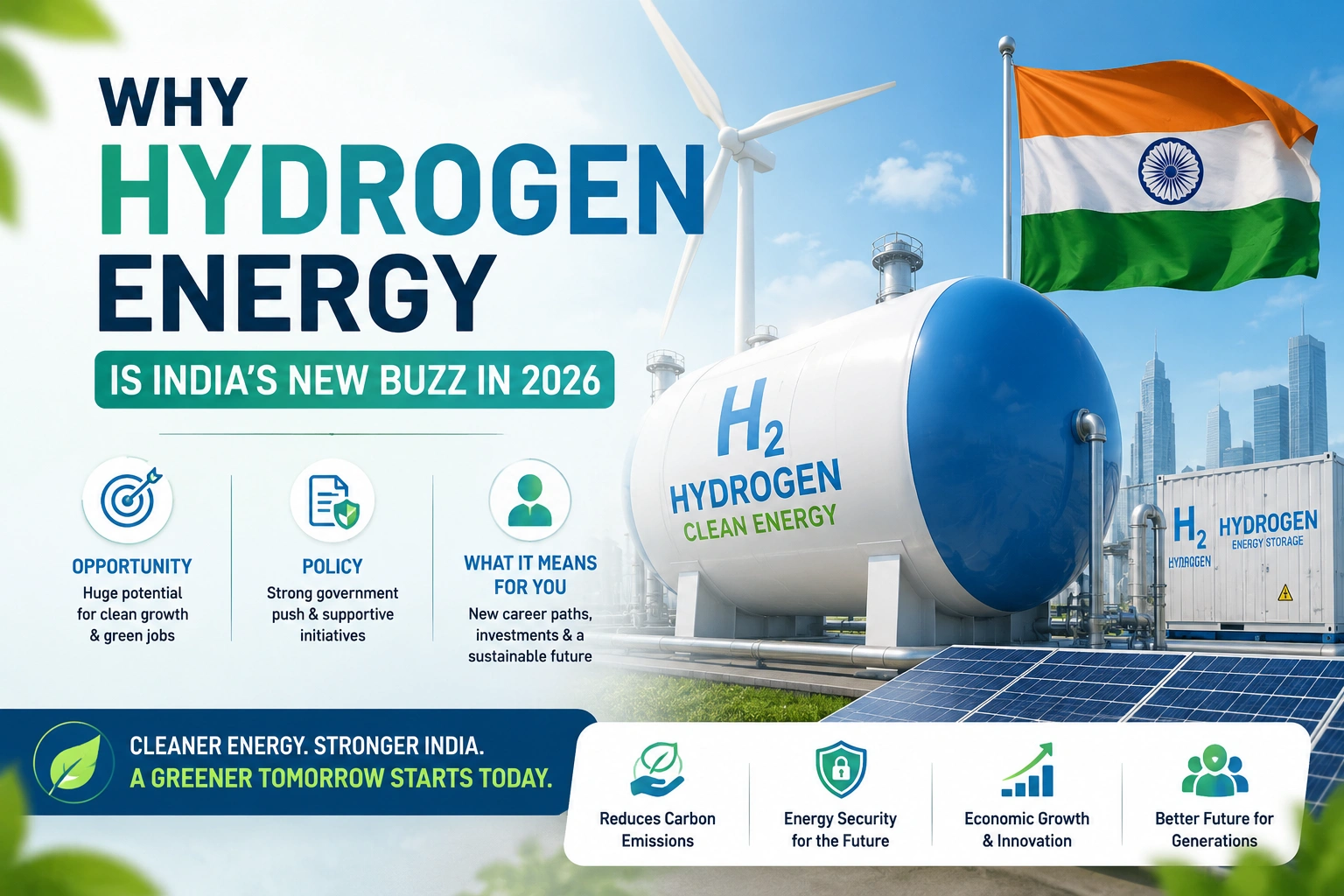
If you have been on X/Twitter in India today, one hashtag has been impossible to miss: #HydrogenEnergyIsNewBuzz. And it is not just social media hype. India has officially declared 2026 its "year of execution" for green hydrogen — and the government has backed that declaration with real money, real policy, and real projects that are now moving from blueprint to construction.
But what exactly is green hydrogen? Why is it suddenly the biggest conversation in Indian energy? And what does it mean for businesses, investors, and everyday citizens? This guide breaks it all down in plain English — with the latest numbers from 2026.
What Is Green Hydrogen? (And Why It's Different)
Hydrogen is the most abundant element in the universe — but most of the hydrogen we produce today is "grey hydrogen," made from natural gas in a process that releases large amounts of CO₂. Green hydrogen is different: it is produced by splitting water (H₂O) into hydrogen and oxygen using electricity generated entirely from renewable sources like solar and wind. No fossil fuels. No carbon emissions.
The result is a clean, storable, and transportable fuel that can power industries, vehicles, and cities in ways that solar panels and batteries alone cannot. As DSK Legal's 2026 energy analysis notes, green hydrogen is "conversion-based" rather than "extraction-based" — meaning unlike oil, it is not limited to a few geographic regions. Any country with renewable energy can produce it. For India, that is a game-changing advantage.
Why 2026 Is a Turning Point for India
India has been talking about green hydrogen for years. What is different in 2026 is that the talking has largely stopped and the building has begun. According to Law.Asia's May 2026 report, India's green hydrogen pipeline has grown to nearly 40,000 tonnes per annum, up from just 8,000 tonnes in February 2026 — a 5x jump in under six months. Six major projects have already been commissioned across the steel, refinery, and industrial manufacturing sectors.
India's Green Hydrogen Numbers at a Glance (2026)
| Indicator | Current Status (2026) |
|---|---|
| Current Production Capacity | 8,000 tonnes per annum (Feb 2026) |
| Pipeline Projects | ~40,000 tonnes per annum |
| 2030 Target | 5 million metric tonnes per annum (MMTPA) |
| Electrolyser Manufacturing Incentive | ₹4,440 Crore allocated |
| Companies Awarded Electrolyser Manufacturing | 15 companies, 3,000 MW cumulative capacity |
| Green Ammonia Capacity Discovered | 7,24,000 TPA for 13 fertiliser units |
| ISTS Waiver Period | 25 years (for plants commissioned by Dec 2030) |
| India's Renewable Energy Target | 500 GW by 2030 |
India's National Green Hydrogen Mission (NGHM) — What It Includes
The backbone of India's green hydrogen push is the National Green Hydrogen Mission (NGHM), launched by the Ministry of New and Renewable Energy (MNRE). According to SolarQuarter's February 2026 report, the NGHM includes four major pillars:
- Electrolyser Manufacturing Incentive: 15 companies have been awarded a combined 3,000 MW of electrolyser manufacturing capacity — building the domestic supply chain needed to reduce India's dependence on imported equipment.
- Refinery Procurement Scheme: Two companies have been awarded 20,000 TPA supply contracts to provide green hydrogen directly to Indian oil refineries — creating guaranteed demand for early producers.
- Green Ammonia: SECI has discovered prices for 7,24,000 TPA of green ammonia for supply to 13 fertiliser plants across India — a massive boost for the agriculture sector's decarbonisation.
- ISTS Waivers: Green hydrogen plants commissioned before December 31, 2030 receive a 25-year exemption from Inter-State Transmission System charges — dramatically reducing operational costs.
Which Companies Have Already Commissioned Green Hydrogen Projects in India?
Green hydrogen is no longer just a government target in India. According to Renewable Watch's June 2026 report, six projects are already live and operating:
| Company | Project Location | Sector |
|---|---|---|
| GAIL | Vijaipur, MP | Gas / Pipeline |
| BPCL (Bharat Petroleum) | Bina Refinery, MP | Oil Refinery |
| JSPL – Jindal Renewables | Angul, Odisha | Green Steel |
| JSW | Vijayanagar, Karnataka | Green Steel |
| Hero Future Energies | Tirupati, Andhra Pradesh | Industrial Manufacturing |
| INOXAP | Chittorgarh, Rajasthan | Industrial (Asahi Glass) |
Together these projects account for approximately 70 MW of installed electrolyser capacity producing around 10,000 tonnes of green hydrogen per annum. It is a small fraction of the 2030 target — but it proves the technology works at commercial scale in Indian conditions.
Why Green Hydrogen Is Critical for India's Energy Security
India imports over 85% of its crude oil — making it deeply vulnerable to global price shocks and geopolitical instability. Every rupee rise in the dollar-denominated oil price adds to the current account deficit and puts pressure on the rupee. Green hydrogen offers a path to energy independence that solar and wind alone cannot provide, because it can be stored, transported, and used in industries where direct electrification is not practical — like steel manufacturing, fertiliser production, heavy transport, and shipping.
As the Law.Asia analysis points out: "For India, it bolsters energy security by reducing import dependence and mitigating the price vulnerability inherent in traditional hydrocarbon markets." In a world where oil supply disruptions affect millions of Indian homes, that independence is not just an environmental goal — it is a national security priority.
The Real Challenges India Must Solve
Green hydrogen is not without its problems — and being honest about them is important. Here are the three biggest hurdles India faces in scaling up:
- Cost of production: Producing 1 kg of hydrogen requires 50–55 units of electricity. At current renewable energy costs, green hydrogen remains more expensive than grey hydrogen made from natural gas. Bringing costs down requires scale, better electrolysers, and cheaper renewable power.
- Storage and transportation: Hydrogen is the smallest molecule known — it is notoriously difficult to store and transport without leakage. Building the pipeline and storage infrastructure needed to move hydrogen from production sites to industrial clusters requires massive capital investment.
- Grid readiness: Industrial users need a 24/7 consistent hydrogen supply. But renewable energy generation is intermittent — the sun does not always shine and the wind does not always blow. Bridging that gap requires expensive battery storage or pumped hydro systems that India does not yet have at scale.
Business Opportunities: Who Can Benefit from India's Hydrogen Push?
The green hydrogen transition is not just a government story. It creates real business and investment opportunities across the value chain:
| Opportunity Area | Who Benefits |
|---|---|
| Electrolyser manufacturing | Engineering firms, EPC companies, foreign OEMs entering India |
| Renewable energy for hydrogen production | Solar and wind developers, IPPs |
| Green steel manufacturing | Steel companies like JSPL, JSW, Tata Steel |
| Green fertilisers and ammonia | Fertiliser companies, agricultural sector |
| Storage and transport infrastructure | Pipeline operators, logistics companies |
| Green hydrogen export | India as a global supplier to Japan, South Korea, EU |
| Policy and legal advisory | Law firms, consulting firms, ESG advisors |
| Equity investment | Investors in clean energy and green infrastructure stocks |
India's Green Hydrogen vs The World
India is not alone in this race. The European Union, the United States, Japan, South Korea, and Australia are all investing heavily in green hydrogen. But India has a structural advantage that most of these countries do not: abundant solar and wind resources combined with lower labour costs, which together give India the potential to produce green hydrogen at among the lowest costs in the world by 2030. The government has explicitly positioned India as a future green hydrogen exporter — competing for contracts from energy-importing nations in Asia and Europe.
What Should You Watch in 2026?
- New tender announcements from SECI and NTPC for green hydrogen production capacity
- Electrolyser cost reductions as domestic manufacturing scales up under the NGHM incentive scheme
- State-level hydrogen policies from Rajasthan, Gujarat, Andhra Pradesh, and Tamil Nadu — all competing to become green hydrogen hubs
- India–Japan and India–EU green hydrogen trade agreements, which are currently in negotiation
- Stock market movement in companies exposed to green hydrogen: NTPC, GAIL, BPCL, Reliance, L&T, and clean energy specialists
Frequently Asked Questions
What is green hydrogen and why is it trending in India?
Green hydrogen is hydrogen gas produced using renewable electricity to split water — with zero carbon emissions. It is trending in India in July 2026 because the government has declared 2026 the "year of execution" for the National Green Hydrogen Mission, with ₹4,440 Cr in new incentives and six major projects already commissioned across steel, refinery, and industrial sectors.
What is India's green hydrogen target for 2030?
India's National Green Hydrogen Mission targets 5 million metric tonnes of green hydrogen production per annum by 2030, supported by 500 GW of renewable energy capacity. This would make India one of the world's largest green hydrogen producers.
Which Indian companies are producing green hydrogen in 2026?
The six companies that have commissioned green hydrogen projects in India as of 2026 are GAIL (Vijaipur), BPCL (Bina Refinery), JSPL–Jindal Renewables (Angul), JSW (Vijayanagar), Hero Future Energies (Tirupati), and INOXAP (Chittorgarh). Together they produce approximately 10,000 tonnes per annum.
What government incentives are available for green hydrogen in India?
Key incentives under India's NGHM include ₹4,440 Cr in electrolyser manufacturing subsidies, a 25-year exemption from Inter-State Transmission System (ISTS) charges for plants commissioned by December 2030, duty benefits under the SEZ Act for renewable energy equipment, and guaranteed procurement contracts for green hydrogen supply to Indian refineries and fertiliser plants.
What are the challenges of green hydrogen in India?
The main challenges are high production costs (producing 1 kg requires 50–55 units of electricity), expensive storage and transportation infrastructure (hydrogen is extremely difficult to contain), grid intermittency (renewable energy is not always available 24/7), and raw material shortages for electrolysers. India must solve these at scale to meet its 2030 target.
Is green hydrogen a good investment opportunity in India?
Green hydrogen presents significant investment opportunities across the value chain — from electrolyser manufacturing and renewable energy to green steel, green ammonia, and export contracts. Companies like NTPC, GAIL, BPCL, JSW, JSPL, and L&T are the primary publicly listed beneficiaries. As with any early-stage energy transition, the risks are real — but so is the long-term scale of the opportunity.
Sources: SolarQuarter | Renewable Watch | Law.Asia — DSK Legal | S&P Global Energy



Comments
0Be the first to leave a comment.