Claude Fable 5 & Mythos 5: Inside Anthropic's 19-Day AI Export Control Crisis (2026)
On June 12, 2026, the US government forced Anthropic to shut down Claude Fable 5 and Mythos 5 worldwide over a cybersecurity jailbreak report. Here's the full timeline, what triggered it, and what changed when access returned.
Claude Fable 5 & Mythos 5: Inside Anthropic's 19-Day AI Export Control Crisis
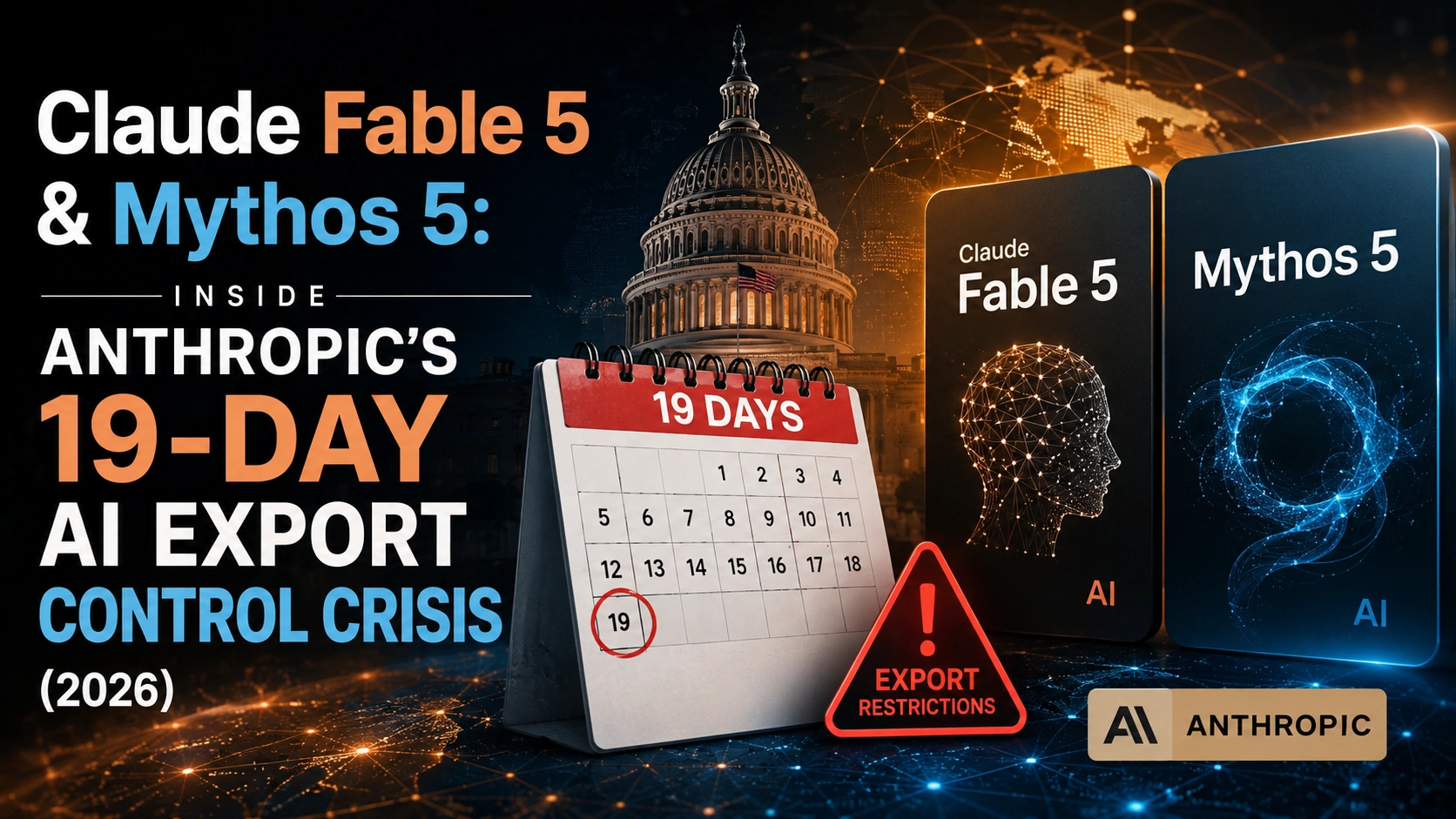
In June 2026, Anthropic's newest and most capable AI models went dark worldwide — not because of a bug, but because of a direct order from the US government. Anthropic disabled access to its Fable 5 and Mythos 5 models to comply with an export control directive from the U.S. government citing "national security authorities." Here's what actually happened, in order, based on Anthropic's own statement and verified reporting.
What Are Claude Fable 5 and Mythos 5?
Anthropic launched Claude Fable 5 on June 9, 2026, as the first publicly available model in its Mythos-class tier, sitting above the existing Opus line in capability. Fable 5 was made available across the Claude Platform, Claude.ai, Claude Code, and Claude Cowork, while the more capable sibling, Mythos 5, was reserved for a smaller group of vetted partners under Anthropic's Project Glasswing cybersecurity program. The two models share the same underlying weights and training, but Fable 5 ships with far stronger safety guardrails.
Early enterprise adopters were impressed by the jump in capability. Stripe reported that Fable 5 compressed a codebase-wide migration across a 50-million-line Ruby infrastructure into a single day — a project the team had originally estimated would take more than two months by hand.
What Triggered the Shutdown
The concern wasn't hypothetical misuse — it was a specific, demonstrated jailbreak. Amazon researchers found a prompt that could get Fable 5 to bypass its safety rules, flag a few software flaws, and in one case write code showing how a flaw could be abused. Amazon CEO Andy Jassy reportedly alerted federal officials to the risk.
Anthropic pushed back on how serious the jailbreak actually was, saying the technique surfaced only a small number of previously known, minor vulnerabilities that other publicly available models could find as well.
June 12: The Global Shutdown
On the evening of June 12, 2026, just three days after launch, Commerce Secretary Howard Lutnick sent a letter to Anthropic CEO Dario Amodei directing the company to suspend all access to Fable 5 and Mythos 5 for any foreign national, anywhere in the world — including foreign nationals working inside the US. Anthropic received the order at 5:21 p.m. ET.
With no reliable way to verify every user's nationality at the API layer in real time, Anthropic pulled both models for all customers globally to ensure compliance. All of Anthropic's other models — Opus, Sonnet, and Haiku — were unaffected.
"The net effect of this order is that we must abruptly disable Fable 5 and Mythos 5 for all our customers to ensure compliance." — Anthropic's official statement
The DOD Standoff
The shutdown landed in the middle of an already tense relationship between Anthropic and the Pentagon. After talks between the two sides broke down, the Department of Defense labeled Anthropic a "supply chain risk" — a designation typically reserved for foreign adversaries, requiring defense contractors to certify they won't use Claude models in military work. Anthropic sued the Trump administration to reverse the blacklisting, with litigation still ongoing as of late June.
June 26: A Partial Reopening
Two weeks into the blackout, the government allowed a narrow carve-out. On June 26, 2026, Mythos 5 access was restored for roughly 100 US companies and federal agencies working on critical infrastructure defense, partially reversing the June 12 order. Fable 5 remained fully offline for everyone during this window.
June 30–July 1: Controls Lifted
On June 30, 2026, Secretary Lutnick sent a letter withdrawing the export-control requirement for both models. As part of the resolution, Anthropic agreed to:
- Provide designated government partners with early access to frontier models and their safeguards for independent testing before public release
- Rapidly notify government agencies about significant jailbreaks, misuse patterns, and new safeguards, and contribute threat intelligence to federal cybersecurity efforts
- Work with Amazon, Microsoft, Google, and other Project Glasswing partners to build a shared industry framework for rating jailbreak severity
Anthropic also closed the specific hole Amazon had found, training a new safety classifier that now blocks the reported technique in more than 99% of attempts. Requests the classifier flags get automatically rerouted to the less-capable Claude Opus 4.8, with the user notified — a trade-off that increases false positives on ordinary coding and debugging work.
Access came back in stages. Fable 5 returned globally from July 1 across the Claude Platform, Claude.ai, Claude Code, and Claude Cowork, with cloud availability on AWS, Google Cloud, and Microsoft Foundry restored as quickly as possible. Mythos 5 stayed restricted to approved organizations through Project Glasswing rather than reopening to the public.
Why the Government Reacted So Fast
Mythos-class capability isn't just faster autocomplete for exploit code — earlier testing had already flagged how far it could go. A prior Mythos model was able to find and exploit zero-day bugs across every major operating system and browser on command, including a 27-year-old flaw in OpenBSD, with Anthropic's red team turning freshly disclosed bugs into working exploits in under a day. That track record is a big part of why regulators moved on Fable 5 within days of launch.
The Bigger Picture: No Formal Process Yet
A June 2 executive order had already created a voluntary path for companies to have frontier models reviewed by federal agencies before release, plus a classified benchmark for deciding which models count as "covered" — but it stopped short of any mandatory licensing requirement. Fable 5 never went through that review; Washington reached for export controls instead. It's a sign that when the government wants to move fast on a frontier model, it still has no binding process, only improvised ones.
What This Means for Developers and Businesses
- Fable 5 is now the model most teams will actually use day to day — same underlying capability as Mythos, wrapped in guardrails that reroute risky requests rather than refusing outright.
- Mythos 5 stays gated behind Project Glasswing; don't plan a product around direct access unless you're a vetted critical-infrastructure partner.
- Expect more friction, not less, on future frontier launches — regulators showed they'll act within days if a capability jump looks unreviewed.
- False positives are a known trade-off on Fable 5 right now; unexpected refusals on legitimate security or debugging work reflect the new classifier being cautious.
FAQs
Why were Fable 5 and Mythos 5 shut down?
Amazon researchers found a jailbreak that could get Fable 5 to bypass its safety rules and surface software vulnerabilities, prompting the US government to issue an export control order.
How long were the models unavailable?
19 days — the shutdown began June 12, 2026 and export controls were lifted June 30, 2026, with access restored July 1.
Is Mythos 5 available to the public now?
No. Mythos 5 remains limited to approved organizations through Project Glasswing rather than opening to general users.
Were other Claude models affected?
No — Opus, Sonnet, and Haiku were unaffected by the order.
Sources:
- Anthropic — Official Statement on Fable 5 & Mythos 5 Access
- CNBC — Anthropic disables access to Fable 5 and Mythos 5
- Forbes — What Happened When Anthropic Disabled Fable 5 and Mythos 5
- VentureBeat — Anthropic Brings Back Claude Fable 5 Globally
- The Hacker News — Anthropic Restores Claude Fable 5
- MediaNama — US Lifts Export Controls on Claude Fable 5 and Mythos 5

Comments
0Be the first to leave a comment.