
Top 7 Web Development Trends in 2026 Every Developer Must Know
Web development in 2026 looks nothing like it did three years ago. AI writes your boilerplate, TypeScript is now the baseline, and edge computing has moved from theory to production. Here are the 7 biggest trends shaping how websites and apps get built this year.
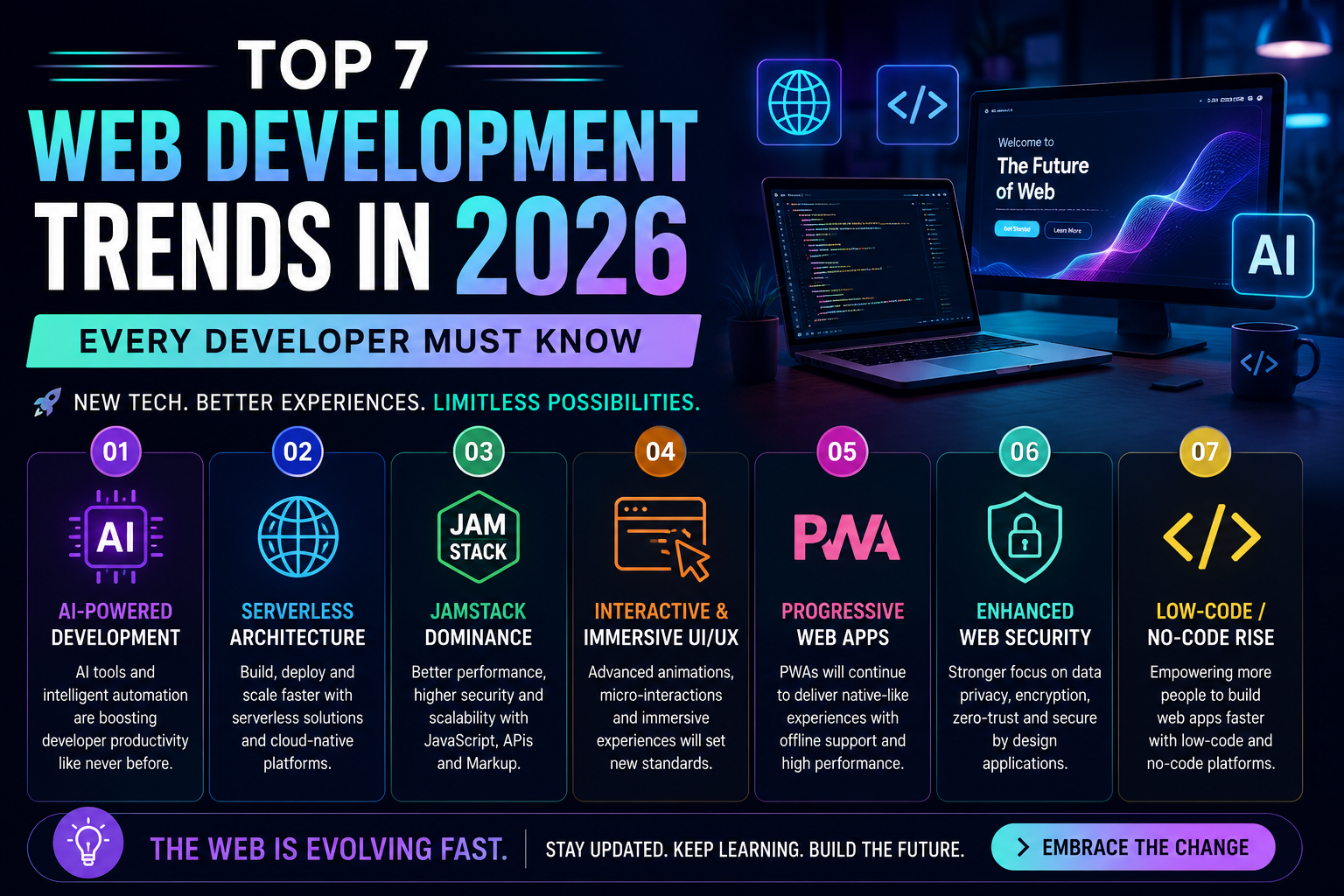
Web development has always moved fast. But 2026 is different. The tools developers reach for every single day have fundamentally changed — not just improved, but changed in kind. AI is now writing code alongside you, TypeScript has essentially replaced plain JavaScript in professional environments, and the idea of deploying your app to a single central server feels increasingly old-fashioned.
Whether you are a beginner trying to figure out what to learn first, a mid-level developer wondering if your skills are still relevant, or a business owner trying to understand what your tech team should be building with — this guide gives you a clear, honest look at where web development actually stands in 2026.
1. AI-First Development Is Now the Default
A few years ago, AI tools for developers were an interesting experiment. In 2026, they are as fundamental to the workflow as a code editor. Tools like GitHub Copilot, Cursor, and Claude Code now suggest entire functions, scaffold full-stack features from a design file or a plain text prompt, catch edge cases, and help developers navigate unfamiliar codebases in minutes instead of hours.
The impact is concrete: developers who use AI-assisted tools consistently complete tasks significantly faster than those who do not. The nature of the job is shifting too — developers today spend less time writing boilerplate and more time on architecture, user experience, and reviewing the output AI produces. The skill that matters now is not just knowing how to code but knowing how to direct, evaluate, and refine what AI generates.
For beginners, this is actually good news. The entry barrier to building something real has dropped considerably. You do not need to memorise syntax or spend hours on documentation — you need to understand concepts clearly enough to give good instructions and spot problems in the output.
2. Meta-Frameworks Have Become the Standard Starting Point
The days of debating which router library to use or how to configure your bundler are largely behind us. In 2026, most professional web projects start with a meta-framework — and Next.js is the dominant choice for React-based teams, with Nuxt serving the Vue ecosystem.
What has changed is how much these frameworks handle on their own. Routing, data fetching, caching, rendering strategy, API endpoints — all of it now lives in a single, well-structured project. React Server Components, which allow you to render components directly on the server and send only the necessary JavaScript to the browser, have matured from an experimental idea into a production-ready default. The result is faster page loads, better SEO, and cleaner code architecture.
For developers who have been building SPAs (Single Page Applications) the traditional way — everything rendered on the client — the mental model shift to server-first thinking is the biggest adjustment of 2026. But it is worth making. Users expect pages that load instantly, and search engines reward sites that deliver real content in the initial HTML.
3. TypeScript Has Taken Over — Plain JavaScript Is Now "Legacy"
If you are still writing plain JavaScript for a professional project in 2026, most teams would consider that a technical decision that needs justification. TypeScript — JavaScript with a type system layered on top — has become the baseline for frontend and full-stack development.
The reason is simple: as web applications handle more complex logic, manage more data, and integrate with more services, the cost of a type error caught at runtime (when a real user experiences a bug) versus compile time (before anything reaches production) is enormous. TypeScript catches entire categories of bugs before the code ever runs.
The ecosystem has followed. Most major libraries now ship TypeScript types by default. AI coding tools produce TypeScript. New documentation assumes TypeScript. If you are learning web development today and have not yet made the switch, adding TypeScript to your skillset is not optional — it is the most immediately career-relevant step you can take in 2026.
4. Edge Computing Has Moved from Theory to Production
For years, edge computing sounded like a buzzword reserved for enterprise engineering blogs. In 2026, it is a practical tool that individual developers deploy on platforms like Vercel, Cloudflare Workers, and AWS Lambda@Edge.
The idea is straightforward: instead of routing every user request to a central server in one physical location, edge computing processes requests in data centres physically close to where each user is located. The practical effect is dramatically lower latency — pages load faster in Mumbai, São Paulo, and Lagos without any code changes, just a deployment configuration.
In 2026, edge computing powers real-time personalisation, authentication checks, A/B testing, and content delivery for high-traffic applications. A 0.1-second improvement in mobile page load time can increase retail conversion rates by up to 8.4% — which is why even mid-sized businesses are now thinking about edge architecture, not just tech giants.
5. Progressive Web Apps Are Replacing Native Apps for Many Use Cases
Building a separate iOS app and Android app on top of a web product used to be considered essential for reaching mobile users. In 2026, Progressive Web Apps (PWAs) have closed enough of the gap that many businesses are skipping native development entirely for their first version — and some are retiring their native apps altogether.
A PWA is a web application that behaves like a native app: it works offline, sends push notifications, installs on a home screen, and loads instantly on repeat visits through service worker caching. Modern PWAs even support biometric authentication and background synchronisation — features that were exclusive to native apps just a few years ago.
The business case is compelling: one codebase, one development team, one deployment pipeline — and users on every platform. For startups and indie developers especially, this is the most cost-effective path to a high-quality mobile experience in 2026.
6. WebAssembly Is Bringing New Power to the Browser
WebAssembly (often called Wasm) is one of the more technically significant shifts in web development that does not always get the mainstream attention it deserves. In simple terms, WebAssembly allows languages like Rust, C++, and Go to run inside a web browser — at near-native speed.
Why does this matter? Because there are entire categories of applications that JavaScript alone was never fast enough to power well in a browser: video editing, 3D graphics, AI model inference, data science tools, and complex simulations. WebAssembly removes that ceiling. Applications that previously required a desktop install or a heavy server-side computation can now run entirely in a browser tab.
In 2026, WebAssembly is seeing serious adoption in developer tools, creative software, and AI-powered web features. It is not something every web developer needs to use directly today — but understanding what it enables is increasingly important as the boundary between "web app" and "desktop software" continues to dissolve.
7. Web Security Is No Longer an Afterthought
Security has always mattered in web development. But the threat landscape of 2026 demands that it be built into the development process from the first line of code — not patched in at the end.
Supply chain attacks on npm packages have increased significantly in recent years, with attackers targeting widely used open-source libraries to insert malicious code that gets downloaded by millions of developers. Meta-frameworks, which now handle authentication, data access, and business logic in a single codebase, have expanded the attack surface considerably. A misconfigured server function or a leaky cache in a Next.js app can expose data that once required a dedicated backend vulnerability to reach.
The practical response in 2026 is treating security as part of code review, not a separate audit. That means validating inputs at the edge before they reach server logic, regularly auditing dependencies for known vulnerabilities, using environment variables properly, and understanding what your framework does by default — not assuming it is safe.
What Should You Learn First in 2026?
If you are starting from scratch or trying to prioritise your learning in 2026, here is the honest answer:
- Start with HTML and CSS fundamentals. They still underpin everything. No shortcut here.
- Learn JavaScript properly, then move to TypeScript immediately. Do not spend years in plain JS — the transition is easier when started early.
- Pick Next.js as your first framework. It is the most in-demand, best-documented, and most employer-relevant meta-framework available.
- Use AI tools from day one. GitHub Copilot, Claude, or Cursor — pick one and integrate it into how you learn, not as a replacement for understanding, but as a tool for going faster once you do.
Web development in 2026 rewards developers who can think clearly about systems, work with AI effectively, and care about the performance and security of what they build. The specific tools will keep changing. The underlying skills that make someone genuinely good at this do not.
Frequently Asked Questions
What is the most important web development skill to learn in 2026?
TypeScript is the single most immediately valuable skill to add in 2026 if you already know JavaScript. For complete beginners, HTML, CSS, and JavaScript fundamentals remain the essential starting point before any framework.
Is Next.js worth learning in 2026?
Yes. Next.js is the most widely used React meta-framework in 2026 and is the default choice for most new professional web projects. Learning Next.js gives you access to the largest ecosystem, the most job opportunities, and the best documentation.
What is edge computing in web development?
Edge computing means running your application logic in servers located physically close to your users around the world, rather than a single central server. This reduces latency and improves load times for users in different countries. Platforms like Vercel and Cloudflare Workers make edge deployment accessible to individual developers.
Is plain JavaScript still used in 2026?
Plain JavaScript is still used in some legacy projects and for simple scripts. However, for professional web development in 2026, TypeScript has become the baseline — most companies, frameworks, and libraries now default to TypeScript, and writing plain JS in a professional project is considered a legacy choice that requires explanation.
What is a Progressive Web App (PWA)?
A Progressive Web App is a website that behaves like a native mobile app — it works offline, can be installed on a home screen, sends push notifications, and loads instantly on repeat visits. PWAs allow businesses to reach iOS and Android users with a single codebase, without building separate native apps.
Sources: LogRocket | Agility CMS | Hostinger | DEV Community
Comments
0Be the first to leave a comment.