JavaScript for Beginners 2026: Complete Guide to Learning JS from Scratch
JavaScript is the only programming language that runs inside every web browser on earth. This complete beginner's guide covers what JavaScript is, how it works, the step-by-step learning roadmap, best free resources, beginner projects, and career paths with real 2026 salary data — everything in one place.
If you want to build websites, work as a software developer, or understand how the digital world actually works — JavaScript is probably the most immediately useful language you can learn in 2026. Not because it is the most elegant. Not because it pays the most. But because it is everywhere, it is in demand, and the distance between learning it and building something real is shorter than in almost any other language.
This guide gives you the full picture: what JavaScript actually is, why it still matters in 2026, how to learn it efficiently, what to build, where to find work, and what the honest challenges look like. No hype — just a clear map from where you are right now to where you want to be.
What Is JavaScript and Why Does It Run Everything?
JavaScript was created in 1995 by Brendan Eich at Netscape in just ten days. Despite this rushed origin, it became the only programming language that web browsers could run natively — and that single historical accident made it the most deployed programming language in history. Every modern web browser on every device in the world can execute JavaScript without any additional software. That is a distribution advantage no other language has ever matched.
For decades, JavaScript was a client-side language only — meaning it ran in your browser and nowhere else. Then Node.js arrived in 2009, allowing JavaScript to run on servers, and the language exploded into backend development, API building, command-line tools, and eventually desktop and mobile applications. In 2026, a developer who knows JavaScript deeply can work across the entire technology stack: frontend, backend, mobile, desktop, and cloud functions — all in a single language.
JavaScript vs TypeScript: What Beginners Need to Know First
You will encounter TypeScript almost immediately once you start learning JavaScript seriously. TypeScript is Microsoft's typed superset of JavaScript — it adds a type system on top of JavaScript that catches entire categories of bugs before your code runs. According to GitHub's Octoverse 2025 report, TypeScript became the most-contributed language on GitHub by contributor count, overtaking both JavaScript and Python for the first time.
The beginner's decision is straightforward: learn JavaScript first for three to six months until the fundamentals feel natural, then layer TypeScript on top. The transition is much less painful when you already understand what TypeScript is fixing. Trying to learn both simultaneously from day one is the most common mistake beginners make in 2026's JavaScript ecosystem.
JavaScript Career Paths and Salaries in 2026
| Career Path | What You Build | Key Skills | US Salary (2026) |
|---|---|---|---|
| Frontend Developer | Websites, web apps, UIs | React, CSS, TypeScript | $87K – $145K |
| Backend Developer | APIs, databases, servers | Node.js, Express, SQL | $90K – $155K |
| Full Stack Developer | End-to-end web applications | Next.js, Node.js, SQL | $100K – $171K |
| React Native Developer | iOS and Android apps | React Native, TypeScript | $95K – $155K |
| JavaScript Freelancer | Client websites & tools | Vanilla JS, React, Node | Variable — high demand |
In India, JavaScript is one of the most in-demand skills across product startups, IT services, and digital agencies. Cities like Bangalore, Hyderabad, Pune, and Chennai have strong JavaScript hiring at all experience levels. Freelance JavaScript work is also highly available on Upwork and Toptal for developers who build a strong portfolio.
Step-by-Step JavaScript Learning Roadmap
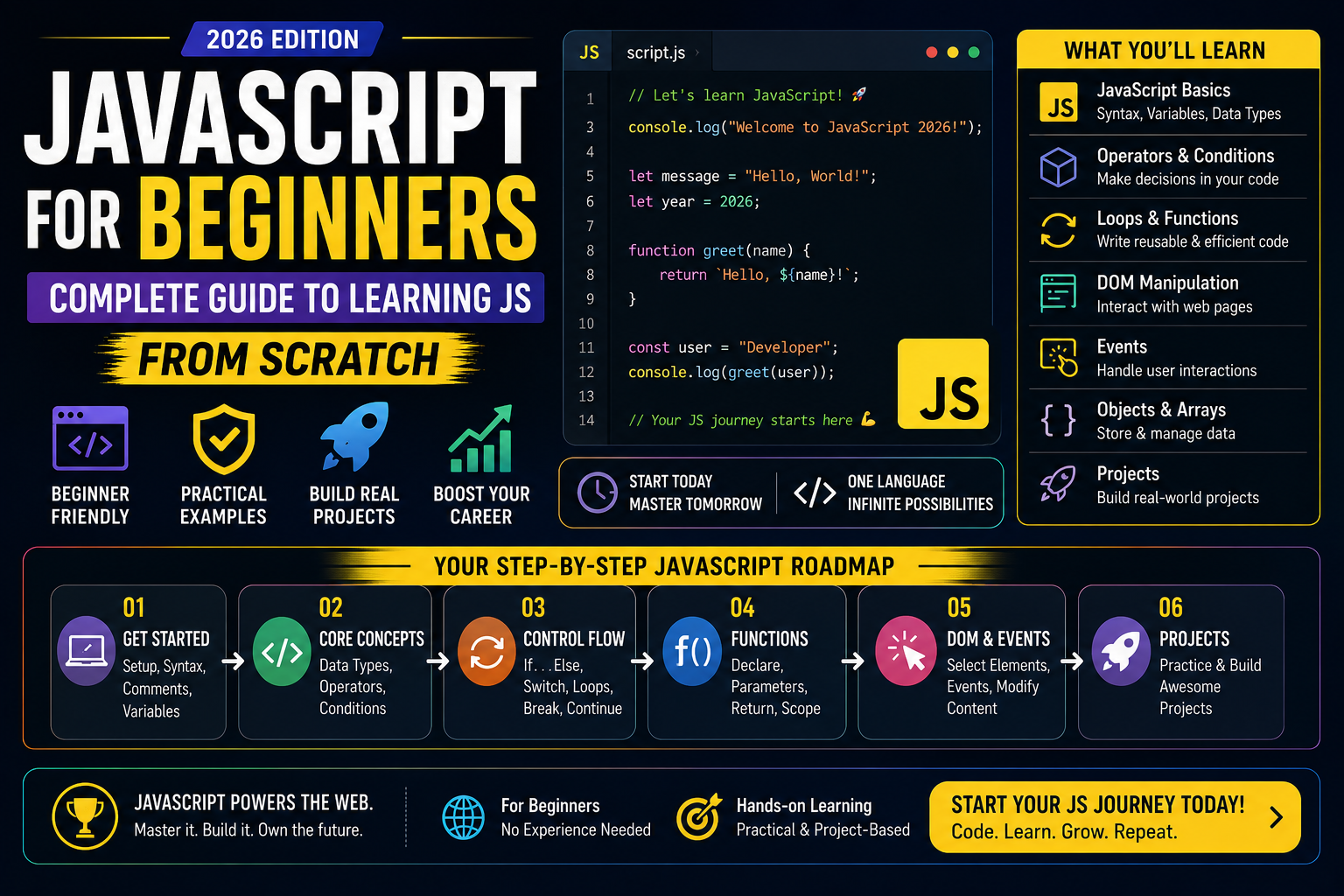
Phase 1 — JavaScript Fundamentals (Weeks 1–4)
Start here and do not rush it. Everything you build later depends on these fundamentals being solid:
- Variables:
var,let,const— and why the difference matters - Data types: strings, numbers, booleans, arrays, objects, null, undefined
- Functions: declaration, expression, arrow functions, scope and closures
- Control flow:
if/else,switch, ternary operators - Loops:
for,while,forEach,map,filter,reduce - DOM manipulation: selecting elements, changing content, handling events
- Error handling:
try/catch, throwing custom errors
Goal for Phase 1: You should be able to write a working programme from scratch that takes input, processes it, and produces a meaningful output — without looking anything up.
Phase 2 — Intermediate JavaScript (Weeks 5–8)
- Asynchronous JavaScript: callbacks, Promises, async/await
- Fetch API: making HTTP requests and handling JSON responses
- ES6+ features: destructuring, spread operator, template literals, optional chaining
- Modules:
import/exportand how JavaScript projects are structured - Local storage and session storage for persisting browser data
- Introduction to npm: installing and using third-party packages
Goal for Phase 2: You should be comfortable reading other people's JavaScript code and extending it without needing to rebuild from scratch.
Phase 3 — Pick Your Framework (Month 2–3)
| Your Goal | Framework | Why |
|---|---|---|
| Frontend web apps | React + Next.js | Most in-demand, largest ecosystem |
| Backend APIs | Node.js + Express | Standard for JS backend development |
| Full stack in one framework | Next.js | Handles frontend and backend together |
| Mobile apps | React Native | iOS and Android from one JS codebase |
| Simple websites fast | Vanilla JS + Vite | No framework overhead, fast builds |
Phase 4 — Build Real Projects (Month 3–6)
No tutorial teaches you what building a real project does. Here are five projects that cover the skills employers actually test for:
- To-Do App: Classic for a reason — covers state management, DOM events, local storage, and CRUD operations in under 100 lines of code.
- Weather App: Fetch real weather data from the OpenWeatherMap free API. Tests async/await, API calls, JSON handling, and conditional rendering.
- Movie Search App: Use the free OMDB API to search for films and display results with posters and ratings. Tests fetch, search debouncing, and dynamic HTML generation.
- Full Stack Blog: Build a simple blog with a Node.js backend and React frontend. Users can create, read, and delete posts. Tests the full JavaScript stack end-to-end.
- Expense Tracker: Track income and expenses with categories, totals, and a chart. Tests state management, data visualisation libraries, and real-world data handling.
Upload every project to GitHub. A GitHub profile with five genuine projects is worth more to most employers than any certificate you can put on a resume.
Best Free Resources to Learn JavaScript in 2026
| Resource | Type | Best For | Cost |
|---|---|---|---|
| javascript.info | Text tutorial | Most comprehensive JS reference for beginners | Free |
| freeCodeCamp JS Curriculum | Interactive | Structured learning with free certificate | Free |
| The Odin Project | Full curriculum | HTML, CSS, JS to full-stack in one path | Free |
| Traversy Media (YouTube) | Video tutorials | Practical project-based tutorials | Free |
| Fireship.io | Video | Fast, modern JS and framework introductions | Free + paid |
| MDN Web Docs | Reference docs | Official JavaScript documentation | Free |
The Honest Challenges of Learning JavaScript
JavaScript has quirks that genuinely confuse beginners — and pretending otherwise sets people up for frustration. Here are the three most common ones worth knowing about in advance:
- Type coercion: JavaScript silently converts between types in ways that produce unexpected results.
1 + "1"gives you"11", not2. Understanding this early saves hours of debugging later. - Asynchronous code: The jump from synchronous thinking to understanding callbacks, Promises, and async/await is the steepest learning curve in beginner JavaScript. Plan to spend extra time here — it is worth it because almost every real-world JavaScript application uses async code.
- Framework overload: React, Vue, Angular, Svelte, Solid, Qwik — the options are overwhelming. Pick React first. It has the largest job market, the best documentation, and the most community support. Explore others once you are employed and have time to compare.
JavaScript in India: Job Market Reality in 2026
JavaScript-related job postings on Naukri.com, LinkedIn, and Indeed India have grown consistently year-over-year. The most in-demand combination in 2026 is React + Node.js + TypeScript — the full-stack JavaScript setup that powers the majority of Indian product startups and SaaS companies. Entry-level React developer salaries in Tier 1 Indian cities range from ₹4 to ₹8 lakh per annum, rising to ₹15 to ₹30 lakh at mid-level for developers with strong portfolios and TypeScript skills.
Freelance JavaScript work is also growing strongly. Indian JavaScript freelancers on Upwork and Toptal are increasingly competitive for international clients, particularly in building React components, Next.js websites, and Node.js APIs. Building a portfolio of three to five real-world projects and a clean GitHub profile is the most direct path to attracting freelance clients in 2026 without any previous work history.
Frequently Asked Questions
Is JavaScript still worth learning in 2026?
Absolutely. JavaScript is used by 69% of professional developers according to the 2025 Stack Overflow Developer Survey and powers virtually every interactive website on the internet. It remains the most in-demand skill for web development roles globally and is essential for anyone wanting to build websites, web applications, or full-stack products.
How long does it take to learn JavaScript from scratch?
With one to two hours of focused daily practice, most beginners can learn JavaScript fundamentals in four to six weeks and become job-ready as a junior developer in six to twelve months. Building real projects alongside your learning is the single most important factor in how quickly you progress — tutorials alone will not get you hired.
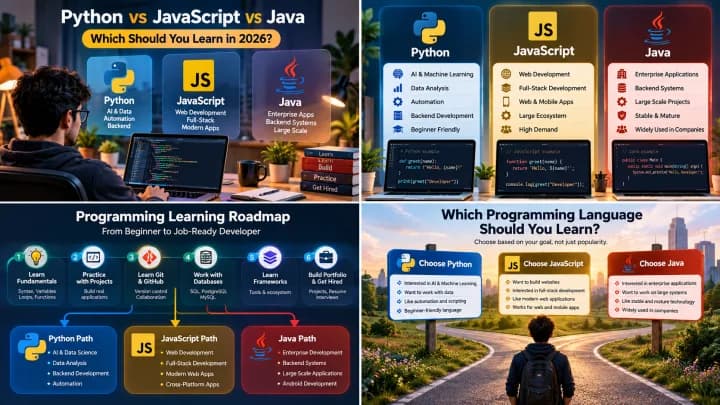
Should I learn JavaScript or Python first in 2026?
If your goal is web development, start with JavaScript — it is the language of the browser and has no equivalent in the web space. If your goal is data science, AI, machine learning, or automation, start with Python. If you are completely undecided, Python has a slightly gentler learning curve for absolute beginners, but JavaScript will get you to a working, visible website faster.
What is the best JavaScript framework to learn in 2026?
React is the most in-demand JavaScript framework in 2026 and appears in the majority of frontend job postings. Next.js, built on top of React, is the recommended choice for full-stack JavaScript development. Learn JavaScript fundamentals first, then React, then Next.js — this sequence covers the widest range of job opportunities in the shortest time.
Can I get a job in India with just JavaScript skills?
Yes, especially if you combine JavaScript with React and have a portfolio of real projects on GitHub. Indian product companies and startups regularly hire junior frontend developers with strong JavaScript and React skills even without a formal computer science degree. The portfolio matters more than the certificate at the entry level in most Indian tech hiring in 2026.
Sources: Stack Overflow Developer Survey 2025 | GitHub Octoverse 2025 | javascript.info | MDN Web Docs | freeCodeCamp JS Curriculum
Comments
0Be the first to leave a comment.