Top 8 Programming Languages to Learn in 2026 (With Salaries, Jobs & Which One Is Right for You)
Choosing the wrong programming language to learn wastes months of effort. This guide breaks down the 8 most in-demand programming languages of 2026 — with real salary data, job market facts, difficulty levels, and honest advice on which one matches your actual goals.
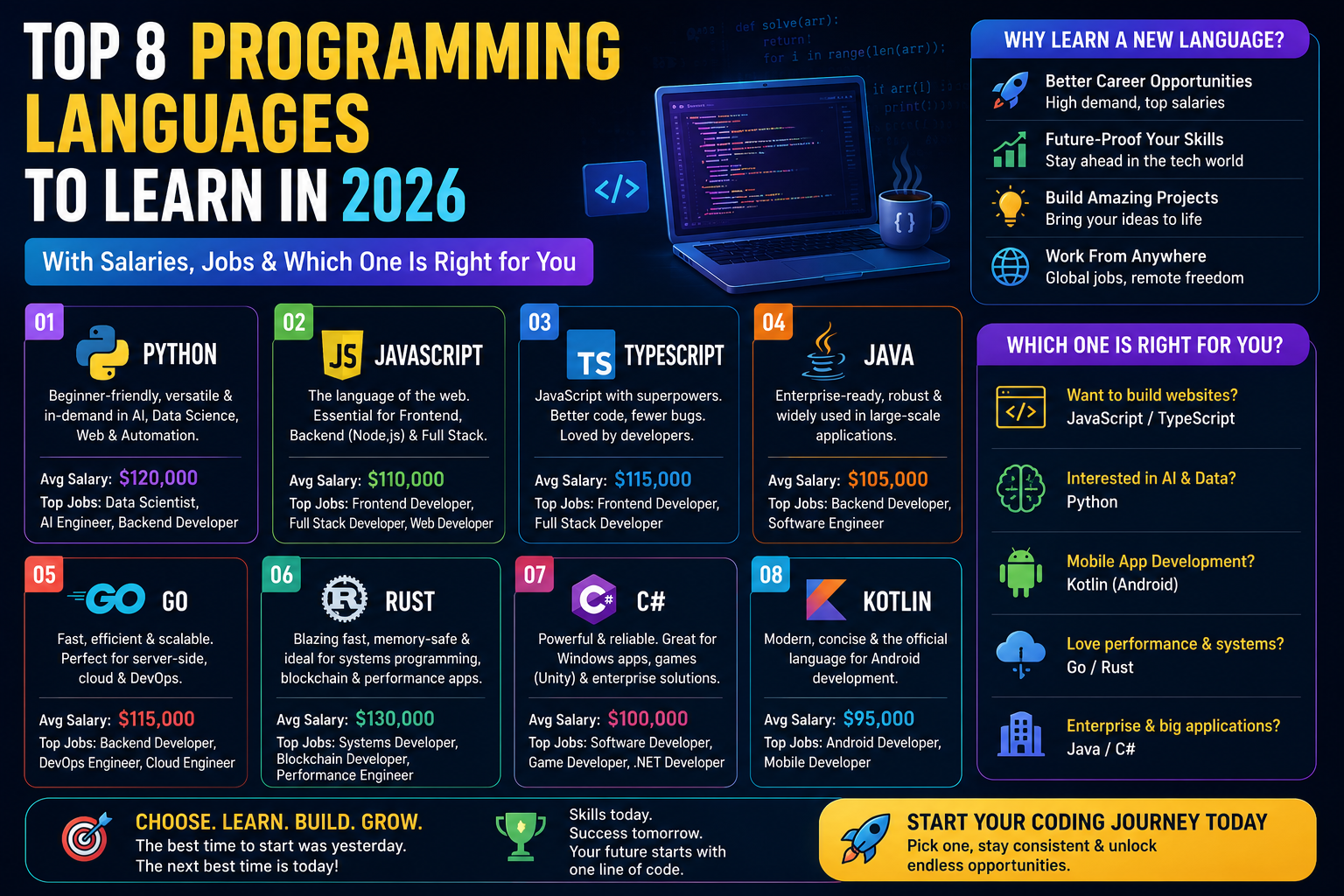
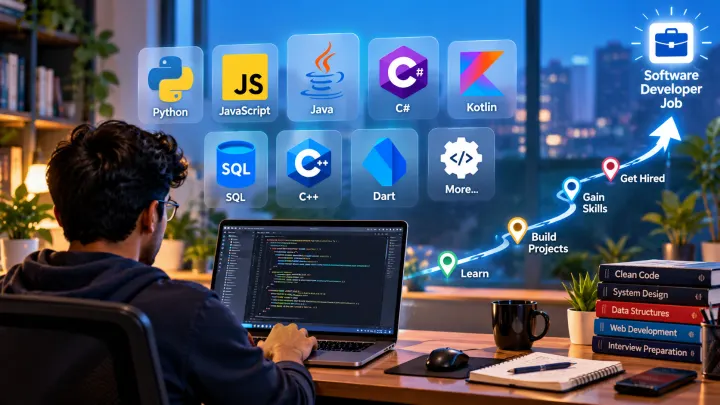
Every year, someone asks the internet which programming language they should learn. Every year, the answers are scattered, often outdated, and almost never based on real job data. This guide is different. Each language below was chosen based on actual hiring demand, real salary figures from 2026, and honest assessments of who each language is best suited for.
The single most important piece of advice before you read any further: do not try to learn all of these at once. Pick one. Learn it properly. Build things with it. The developers who get hired are not the ones who dabbled in ten languages — they are the ones who went deep on one or two and understood them well enough to solve real problems.
With that said, here are the eight programming languages that genuinely matter in 2026.
Quick Comparison: At a Glance
| Language | Best For | Difficulty | Avg US Salary (2026) |
|---|---|---|---|
| Python | AI, ML, data science, automation | Beginner-friendly ⭐ | $98K – $188K |
| JavaScript | Web frontend, Node.js backend | Beginner-friendly ⭐ | $87K – $171K |
| TypeScript | Large-scale web apps, full-stack | Intermediate ⭐⭐ | $130K – $316K (remote) |
| Rust | Systems, infrastructure, security | Advanced ⭐⭐⭐ | $130K – $235K |
| Go (Golang) | Cloud, microservices, DevOps | Intermediate ⭐⭐ | $120K – $180K |
| Java | Enterprise apps, Android, banking | Intermediate ⭐⭐ | $95K – $160K |
| SQL | Databases, data analysis, backend | Beginner-friendly ⭐ | $85K – $140K |
| Kotlin | Android development, JVM backend | Intermediate ⭐⭐ | $110K – $175K |
1. Python — The Most In-Demand Language of 2026
Python has been at or near the top of every major programming language ranking for several years — and in 2026 its lead has actually widened. The reason is straightforward: the explosion of AI and machine learning work has made Python effectively unavoidable in the technology industry. Around 80% of machine learning engineers use Python as their primary language, and it accounts for the largest share of AI-related job postings on platforms like Indeed and LinkedIn.
What makes Python so compelling for beginners is its syntax. It reads almost like English. You can write a working program in ten lines that would take thirty in Java. That readability is not just convenient — it genuinely accelerates how fast you learn and how quickly you can build things that actually work.
Where Python earns its place at the top of this list in 2026 is the sheer range of work it applies to. The same language you use to automate a spreadsheet task can be used to train a neural network, analyse a million rows of financial data, build a web API with FastAPI, or script a deployment pipeline. No other language on this list matches that breadth.
Who should learn Python: Anyone wanting to get into AI, data science, or automation. Also the single best first language for complete beginners who do not yet know what direction they want to go.
2. JavaScript / TypeScript — The Language of the Web
JavaScript is the only programming language that runs natively in every web browser on earth. That one fact has made it one of the most used languages in history — roughly 69% of professional developers use it according to the 2025 Stack Overflow Developer Survey, and it powers the interactive layer of virtually every website you visit.
In 2026, the more important story is TypeScript — Microsoft's typed superset of JavaScript. TypeScript became the most-used language on GitHub by contributor count in 2025, overtaking both JavaScript and Python. For professional web development, TypeScript is now effectively the default. It adds a type system on top of JavaScript that catches bugs before your code ever runs, which becomes increasingly valuable as applications grow in complexity.
The practical advice here is simple: learn JavaScript first, understand the fundamentals properly, then add TypeScript. The transition is much easier when you have a solid JavaScript foundation, and TypeScript's advantages only become obvious once you understand what problems it is solving.
Who should learn JavaScript/TypeScript: Anyone who wants to build websites, web applications, or full-stack products. Also the most in-demand skill for freelancers — JavaScript and TypeScript dominate platforms like Upwork and Fiverr for remote work.
3. Rust — The Highest Paying Language in 2026
Rust is not the most popular language. It is not the easiest to learn. But in 2026 it pays more than any other mainstream programming language, with experienced developers earning between $130,000 and $235,000 in the United States. The reason is structural: Rust solves a problem that has plagued software for decades.
Most systems programming languages — the ones used to build operating systems, browsers, databases, and hardware drivers — give you speed but at the cost of memory safety. Writing C or C++ means manually managing memory, which creates entire categories of bugs that cause crashes, data corruption, and security vulnerabilities. Rust eliminates these at compile time through its ownership system, without sacrificing performance.
Major technology organisations — including Microsoft, Google, Amazon, and the Linux kernel maintainers — have begun adopting Rust specifically because of this safety guarantee. The supply of skilled Rust developers has not kept up with demand, which is the primary driver of the salary premium.
Who should learn Rust: Experienced developers with solid fundamentals who want to move into systems programming, infrastructure, cybersecurity, or WebAssembly. Not recommended as a first language — the learning curve is steep and unforgiving for beginners.
4. Go (Golang) — The Cloud Developer's Language
Go was created at Google to solve a specific problem: building large, concurrent systems that are easy to maintain across large engineering teams. It compiles to a single binary, starts up almost instantly, and handles thousands of simultaneous operations with elegant simplicity. The result is a language that is genuinely pleasant to work with for backend and infrastructure development.
In 2026, Go is the dominant language for cloud-native development. Docker and Kubernetes — the two tools that define how modern applications are deployed and scaled — are both written entirely in Go. Companies like Cloudflare, Uber, Dropbox, and Netflix have standardised on Go for performance-critical backend services. Go developers command a salary premium of roughly 10 to 15 percent above equivalent Python and Java developers, reflecting both the demand and the relative scarcity of experienced Go engineers.
Who should learn Go: Backend developers who want to work in cloud infrastructure, DevOps, or microservices. Excellent choice for developers with some programming experience who want to move into higher-paying infrastructure roles.
5. Java — The Quiet Giant That Still Runs Everything
Java has been declaring itself dead for twenty years. It is not dead. According to 2026 enterprise hiring data, Java is used in production systems at 90% of Fortune 500 companies. The banking sector, healthcare systems, large-scale e-commerce platforms, and most of India's IT services sector run on Java. It is the backbone of Android development and the foundation of the Spring Boot ecosystem, which powers millions of enterprise APIs worldwide.
Java's learning curve is steeper than Python, and its verbosity frustrates beginners who have experienced Python's cleaner syntax. But the trade-off is a language with decades of production-proven reliability, a massive ecosystem of libraries and frameworks, and some of the most stable, well-paid employment opportunities in software engineering — particularly in Indian IT companies and multinational corporations with large engineering teams.
Who should learn Java: Developers targeting enterprise software, Indian IT services companies, or Android application development. Also a strong choice for anyone who wants long-term career stability in a language that will unquestionably still matter in ten years.
6. SQL — The Skill Everyone Needs but Nobody Talks About
SQL is not a general-purpose programming language. You cannot build a website with it. But leaving it off this list would be misleading, because virtually every application that handles data — which is essentially every application — uses SQL or a dialect of it behind the scenes.
In the 2025 Stack Overflow Developer Survey, SQL was the second most commonly used language among professional developers at 58.6%, trailing only JavaScript. Data analysts, backend developers, data engineers, product managers who need to query data, and full-stack developers who build data-backed applications all use SQL on a daily basis.
For Indian developers in particular, SQL is one of the most immediately employable skills available. Almost every entry-level software job, data analyst role, or backend position lists SQL as a requirement. The learning curve is gentle and the ROI on learning it is among the highest of any technical skill in 2026.
Who should learn SQL: Everyone. There is almost no technical career path in 2026 where SQL knowledge is not useful. Learn it alongside whatever primary language you choose.
7. Kotlin — The Future of Android Development
Google officially designated Kotlin as its preferred language for Android development back in 2019. By 2026, the transition is essentially complete — new Android applications are written in Kotlin, and developers maintaining Java-based Android codebases are progressively migrating them. Kotlin is fully interoperable with Java (they run on the same JVM), but offers a significantly cleaner and safer syntax that reduces boilerplate code and eliminates common Java pitfalls like null pointer exceptions.
Beyond Android, Kotlin's Multiplatform feature — which allows code to be shared between Android and iOS projects — is gaining real traction as a way to reduce the cost of maintaining separate mobile codebases. Spring Boot, the dominant Java backend framework, also provides first-class Kotlin support, making Kotlin increasingly viable as a server-side language in JVM environments.
Who should learn Kotlin: Anyone focused on Android development. Also a natural progression for Java developers who want a more modern language that runs on the same platform they already know.
8. C# — Microsoft's Powerhouse for Enterprise and Games
C# occupies a unique position in the 2026 programming landscape. It is the primary language for the entire Microsoft .NET ecosystem — meaning Windows application development, enterprise software built on Azure, and backend APIs using ASP.NET Core. It is also the native scripting language for Unity, the most widely used game engine in the world by market share.
In India and across Asia, .NET demand remains strong in enterprise and financial services contexts. Globally, C# developers are particularly well-compensated in game development and Microsoft-adjacent enterprise software. The language itself is mature, well-designed, and has borrowed many of the best features from newer languages over the years — making it genuinely enjoyable to work with once you get past the initial learning investment.
Who should learn C#: Developers targeting Windows development, enterprise .NET environments, Azure cloud services, or game development with Unity.
Which Language Should You Learn First?
The honest answer depends entirely on what you want to build:
| Your Goal | Start With | Then Add |
|---|---|---|
| AI / Machine Learning | Python | SQL |
| Web Development | JavaScript | TypeScript |
| Android Apps | Kotlin | SQL |
| Cloud / DevOps | Go | Python |
| Enterprise / IT Services (India) | Java | SQL |
| Complete Beginner (unsure) | Python | SQL |
| Maximum Salary (experienced dev) | Rust | Go |
| Game Development | C# | C++ |
One final thought worth taking seriously: the best programming language is not the one with the highest salary ranking or the most hype on social media this month. It is the one you will actually stick with long enough to become genuinely good at it. Consistency beats language choice every single time. Pick one that connects to work you find interesting, and go deep.
Frequently Asked Questions
Which programming language should a complete beginner learn in 2026?
Python is the best first programming language for complete beginners in 2026. Its simple, readable syntax lets you focus on learning programming concepts rather than fighting complicated language rules — and it has the highest job demand and widest range of applications of any language available.
Which programming language pays the most in 2026?
Rust developers earn the highest salaries in 2026, ranging from $130,000 to $235,000 in the United States. TypeScript remote roles at top companies can reach $316,000 annually. Go developers also earn strong premiums of $120,000 to $180,000, typically 10 to 15 percent above equivalent Python or Java engineers.
Is Python still worth learning in 2026?
Absolutely. Python holds over 23% of the TIOBE Index share in 2026 — a larger lead over second place than at any previous point in history. Its dominance in AI, machine learning, data science, and automation makes it more relevant in 2026 than it has ever been.
Should I learn JavaScript or TypeScript in 2026?
Learn JavaScript first, then TypeScript. TypeScript is built on top of JavaScript, so you need a solid JavaScript foundation before TypeScript's advantages become meaningful. Once you understand JavaScript properly, TypeScript is typically learnable in a few weeks and is now required for most professional web development roles.
Is Java still in demand in 2026?
Yes. Java is used in production by 90% of Fortune 500 companies and remains the dominant language in Indian IT services, enterprise banking, healthcare systems, and large-scale e-commerce. It is one of the most stable, long-term career choices in software engineering.
What is the easiest programming language to learn in 2026?
Python and SQL are the easiest programming languages to start with in 2026. Python's syntax is close to plain English, and SQL's logic is straightforward for anyone who understands basic data concepts. Both have gentle learning curves and extremely high practical value from very early in the learning process.
Sources: Stack Overflow Developer Survey 2025 | GitHub Octoverse 2025 | TIOBE Index 2026 | Codism — Highest Paying Languages 2026
Comments
0Be the first to leave a comment.