Learn Python in 2026: Complete Beginner's Guide to Career, Salary & Step-by-Step Roadmap
Python is the world's most popular programming language in 2026 — with 1.19 million job listings and salaries up to $188K. This complete beginner's guide covers why Python matters, the exact learning roadmap, top career paths, salary data, and the best free resources to get started today.
There is a question that almost every person who wants to get into tech eventually asks: "Should I learn Python?" In 2026, the answer is almost always yes — but not because it is trendy or because someone on YouTube told you so. It is yes because the data backs it up in a way that no other language can match right now.
Python holds the top position on the TIOBE Programming Community Index with over 26% share — the highest rating any programming language has ever recorded in the history of the index. There are over 1.19 million job listings on LinkedIn alone that require Python skills. Python job postings grew 41% year-over-year, driven almost entirely by the AI and data science hiring boom. And you do not need a computer science degree to get there.
This guide gives you everything in one place: why Python matters in 2026, a clear step-by-step learning roadmap, real career paths with salary data, beginner project ideas, and the best free resources to start learning today.
What Is Python and Why Is It So Popular?
Python is a high-level, general-purpose programming language first created by Dutch programmer Guido van Rossum in 1991. Van Rossum named it after the British comedy series Monty Python's Flying Circus — which tells you something about the kind of language it was designed to be: approachable, human, and a little less serious than its peers.
What makes Python genuinely different from most other languages is its syntax. It reads like plain English. A for loop in Python looks almost identical to how you would describe a loop in a sentence. This is not just a cosmetic feature — it means you spend less of your early learning fighting the language itself and more time actually understanding how to think like a programmer.
Beyond that, Python's library ecosystem is unmatched. Whatever you want to build — an AI model, a web application, a data dashboard, an automation script, a financial analysis tool — there is almost certainly a Python library that handles most of the heavy lifting. This is why companies from startups to Google, Netflix, NASA, and the Reserve Bank of India all run Python in production.
Why 2026 Is the Best Time to Learn Python
The timing has never been better for one specific reason: the AI industry runs on Python. Every major AI and machine learning framework — TensorFlow, PyTorch, scikit-learn, Hugging Face Transformers, LangChain — is built in Python or has Python as its primary interface. The generative AI boom of the past three years has pulled Python demand along with it to levels that were unimaginable a decade ago.
According to IT Support Group's 2026 analysis, the average Python developer salary increased 10.1% year-over-year — one of the largest single-year increases of any technical skill. For AI and machine learning specialists, salaries regularly exceed $160,000 with just a few years of experience. Even at the entry level, Python-related roles start at salaries that comfortably exceed the median for most non-technical careers.
Python Career Paths and Salary Data (2026)
| Career Path | What You Do | US Salary Range (2026) |
|---|---|---|
| Data Analyst | Clean, analyse and visualise business data | $68K – $100K |
| Backend Developer | Build APIs and server-side apps with Django/FastAPI | $85K – $140K |
| Data Scientist | Build predictive models, find patterns in data | $100K – $155K |
| Automation Engineer | Automate repetitive tasks, testing, deployments | $90K – $130K |
| DevOps / Cloud Engineer | Infrastructure scripting, CI/CD pipelines | $110K – $160K |
| Machine Learning Engineer | Train and deploy ML models for production | $120K – $175K |
| AI Engineer | Build and integrate AI systems and LLM apps | $125K – $188K+ |
For Indian developers, the salary context is different but the opportunity is equally real. Python skills command strong premiums in IT services, product companies, and startups across Bangalore, Hyderabad, Pune, and Delhi NCR. Remote work has also opened direct access to US and European salaries for Python-skilled developers who build strong portfolios and communication skills alongside their technical abilities.
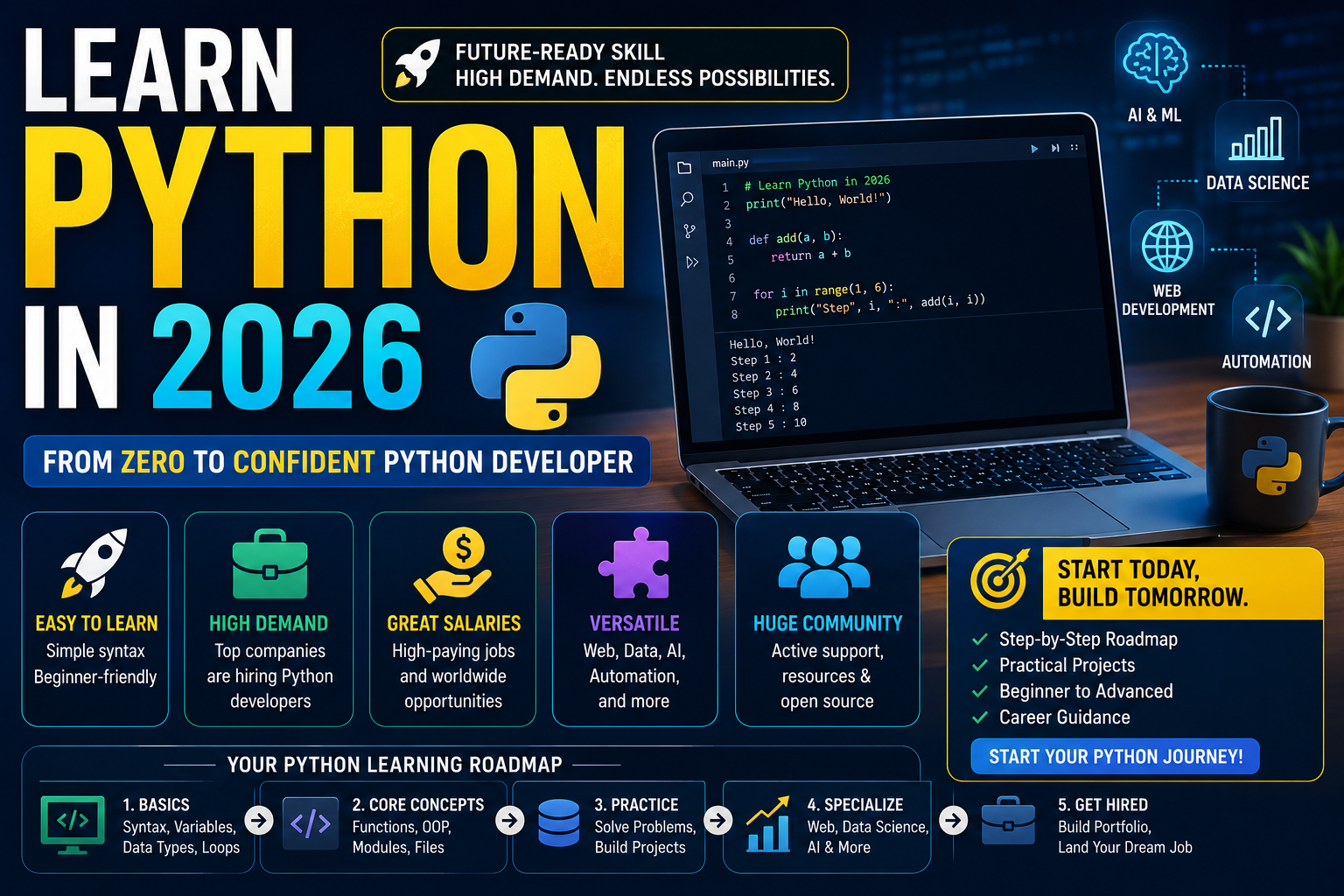
The Python Learning Roadmap: Phase by Phase
The single biggest mistake beginners make when learning Python is jumping between resources without a clear structure. They watch five hours of YouTube, switch to a book, lose motivation, restart from scratch. Here is a focused roadmap that actually gets you to job-ready:
Phase 1 — Core Fundamentals (Weeks 1–3)
Start here and do not rush it. Everything you build later depends on these fundamentals being solid:
- Variables, data types (strings, integers, floats, booleans)
- Lists, dictionaries, tuples, sets
- Conditional statements (
if,elif,else) - Loops (
forandwhile) - Functions — defining them, calling them, understanding scope
- File handling — reading from and writing to files
- Error handling —
try,except, and why it matters
Goal: By the end of Phase 1, you should be able to write a simple programme from scratch that takes input, processes it, and produces a meaningful output.
Phase 2 — Intermediate Python (Weeks 4–6)
- Object-Oriented Programming (OOP) — classes, objects, inheritance, encapsulation
- List comprehensions and lambda functions
- Working with external libraries using
pip - Modules and packages — how to structure larger Python programmes
- Introduction to APIs — making HTTP requests with the
requestslibrary - Regular expressions for text processing
Goal: By the end of Phase 2, you should be comfortable reading other people's Python code and extending it without needing to rebuild from scratch.
Phase 3 — Pick Your Specialisation (Month 2–3)
Python is so broad that trying to learn everything at once is counterproductive. After Phase 2, pick one direction based on the career you want:
| Career Goal | What to Learn in Phase 3 | Key Libraries |
|---|---|---|
| Data Science / AI | NumPy, Pandas, Matplotlib, Scikit-learn | NumPy, Pandas, Matplotlib, Seaborn |
| Web Development | Django or FastAPI, REST APIs, databases | Django, FastAPI, SQLAlchemy, PostgreSQL |
| Automation | Selenium, BeautifulSoup, task scheduling | Selenium, BeautifulSoup, Celery, Airflow |
| Machine Learning | Scikit-learn, TensorFlow or PyTorch basics | Scikit-learn, TensorFlow, PyTorch, Keras |
| AI / LLM Apps | OpenAI API, LangChain, vector databases | LangChain, OpenAI, Pinecone, FastAPI |
Phase 4 — Build Real Projects (Month 3–6)
No employer cares how many tutorials you completed. They care what you have built. Projects are what turn practice into proof. Here are beginner-friendly projects that actually demonstrate useful skills:
- Expense Tracker: A command-line tool that saves income and expenses to a CSV file and calculates your monthly balance. Tests file handling, functions, and data processing.
- Weather Dashboard: Fetch real-time weather data from a free API and display it cleanly in the terminal. Tests API usage, JSON parsing, and conditionals.
- Web Scraper: Use BeautifulSoup to extract job listings or news headlines from a public website and save them to a spreadsheet. Tests libraries, file handling, and loops.
- Student Grade Analyser: Build a script that reads a CSV of student marks and calculates averages, highest scores, and pass/fail status. Tests Pandas, data analysis, and visualisation.
- Simple Chatbot: Use Python and the OpenAI API to build a basic chatbot that answers questions in the terminal. Tests API integration, loops, and string handling.
Upload every project to GitHub. A GitHub profile with five genuine projects is worth more to most employers than any certificate you can put on a resume.
Best Free Resources to Learn Python in 2026
| Resource | Type | Best For | Cost |
|---|---|---|---|
| Python.org Official Tutorial | Text + docs | Core language fundamentals | Free |
| CS50P — Harvard (edX) | Video course | Structured beginner learning | Free (certificate paid) |
| freeCodeCamp Python Course | Video (YouTube) | Beginners who learn by watching | Free |
| Kaggle Python Micro-Course | Interactive | Data science focused Python | Free |
| Corey Schafer (YouTube) | Video tutorials | Intermediate Python and frameworks | Free |
| Automate the Boring Stuff (Book) | Text book | Practical automation projects | Free online |
Common Mistakes Beginners Make When Learning Python
- Tutorial hopping. Finishing 60% of five different courses teaches you less than finishing one properly. Pick one resource and see it through before switching.
- Only watching, never writing. Watching someone else code feels productive but teaches almost nothing. Your hands need to be on the keyboard. Type every example yourself, even if you could just copy it.
- Avoiding errors. Beginners often spend hours trying to prevent errors rather than learning how to read and fix them. Errors are the most efficient teacher you have. Learn to read the traceback and understand what Python is telling you.
- Skipping projects. Tutorials alone will not get you a job. Real projects — even small, imperfect ones — are how you demonstrate that you can apply what you know to solve an actual problem.
- Relying entirely on AI to write your code. AI tools like GitHub Copilot and Claude are genuinely useful for experienced developers. For beginners, they can become a crutch that prevents you from ever developing your own problem-solving instincts. Use them to explain concepts or unblock you — not to write your learning exercises for you.
Do You Need a Degree to Become a Python Developer in India?
No. A growing proportion of working Python developers — in India and globally — are self-taught or bootcamp-trained. Indian employers, especially in startups and product companies, have moved significantly toward skills-first hiring. What matters is what you can demonstrate: your GitHub portfolio, your ability to talk through how you solved a real problem, and your communication skills during a technical interview.
That said, a portfolio without any formal credential requires you to work harder at the networking and application stage. If you complete free courses on Coursera, edX, or Kaggle, many of them offer certificates for free or at low cost. These are not substitutes for skills — but they signal to recruiters that you completed structured learning, which helps at the first filter stage.
Frequently Asked Questions
How long does it take to learn Python in 2026?
With 1 to 2 hours of focused daily practice, most beginners can learn Python fundamentals in 4 to 6 weeks and become job-ready in 6 to 12 months. The timeline shortens significantly if you build real projects alongside your learning rather than only completing tutorials.
Is Python good for getting a job in India in 2026?
Yes. Python is one of the most in-demand skills in Indian IT services, product companies, startups, and data-driven businesses. Cities like Bangalore, Hyderabad, Pune, and Chennai have strong Python hiring across data science, backend development, and automation roles. Remote work has also opened international salary access for Indian Python developers with strong portfolios.
What can you build with Python?
Python can be used to build web applications (Django, FastAPI), data dashboards and visualisations (Pandas, Matplotlib), machine learning models (scikit-learn, TensorFlow, PyTorch), automation scripts, REST APIs, chatbots using LLMs, web scrapers, and data pipelines. It is one of the most versatile languages available.
Is Python hard to learn for complete beginners?
Python is widely considered the easiest major programming language for complete beginners. Its syntax resembles plain English, error messages are relatively readable, and most beginners write their first working programme within a few hours. The difficulty increases as you move into advanced topics like OOP, decorators, or machine learning — but the foundation is genuinely accessible.
What is the best Python framework to learn first?
It depends on your goal. For web development, start with FastAPI for APIs or Django for full web applications. For data science and AI, start with NumPy and Pandas before moving to scikit-learn. For machine learning, PyTorch is currently the dominant framework in research and production environments in 2026.
Can I learn Python for free?
Yes, completely. Python's official documentation, Harvard's CS50P on edX, freeCodeCamp's full Python course on YouTube, Kaggle's Python micro-course, and the book "Automate the Boring Stuff with Python" are all free and collectively more than enough to take you from complete beginner to a job-ready standard.
Sources: TIOBE Index 2026 | Stack Overflow Developer Survey 2025 | IT Support Group | Upwork — Python Career Guide 2026 | DataCamp
Comments
0Be the first to leave a comment.