Best Programming Languages to Learn for Jobs in 2026
Not sure which programming language to learn for your career? This practical 2026 guide compares Python, JavaScript, Java, C#, SQL, C++, Kotlin, and other useful languages based on career paths, learning difficulty, and real-world applications.
Best Programming Languages to Learn for Jobs in 2026
Choosing your first—or next—programming language can feel confusing.
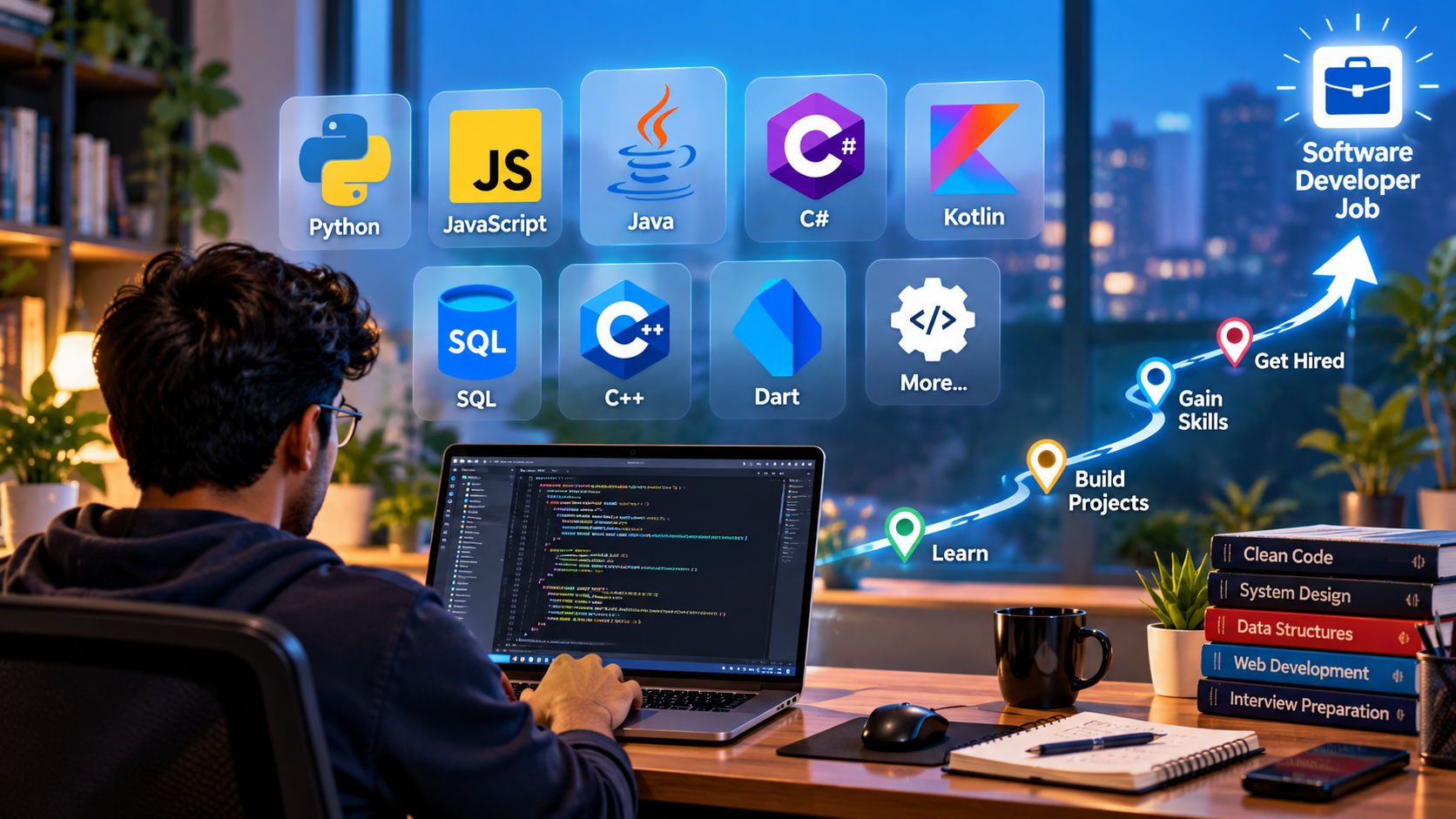
Python is everywhere in AI. JavaScript powers modern websites. Java remains important in enterprise software. C# is widely used with the .NET ecosystem. Kotlin is a strong option for Android development, while SQL remains fundamental for working with data.
So which programming language should you learn if your main goal is getting a job?
There isn't one programming language that is best for every developer.
The right choice depends on the kind of work you want to do: web development, mobile apps, artificial intelligence, enterprise applications, data engineering, game development, cloud software, or something else.
In this guide, we'll compare some of the most useful programming languages to learn in 2026 and, more importantly, explain where each language fits.
Quick Answer: Which Programming Language Should You Learn?
If you don't want to read the complete comparison yet, start here:
| Career Goal | Languages to Consider |
|---|---|
| Beginner programming | Python |
| Front-end web development | JavaScript / TypeScript |
| Full-stack web development | JavaScript / TypeScript + SQL |
| AI and machine learning | Python + SQL |
| Data analysis | Python + SQL |
| Enterprise software | Java or C# |
| Android development | Kotlin |
| Cross-platform mobile development | Dart |
| Game development | C# or C++ |
| Systems programming | C++ or Rust |
| Database-focused roles | SQL + another programming language |
This does not mean you need to learn all of them.
A better strategy is to choose one career path, become comfortable with its primary language, build real projects, and then add supporting technologies.
1. Python
Python remains one of the easiest major programming languages for beginners to approach.
Its syntax is relatively readable, but its real advantage is the number of fields in which it can be used.
Python is commonly associated with:
- Artificial intelligence
- Machine learning
- Data analysis
- Backend development
- Automation
- Scripting
- APIs
- Testing
The 2025 Stack Overflow Developer Survey reported strong growth in Python usage and highlighted its importance in AI, data science, and backend development.
Who should learn Python?
Python makes sense if you're interested in:
- AI and machine learning
- Data science
- Backend development
- Automation
- Learning programming for the first time
What should you learn after Python?
Don't stop after learning syntax.
Move into practical technologies such as:
- Git and GitHub
- SQL
- REST APIs
- FastAPI, Flask, or Django
- Testing
- Basic Linux
- Deployment
- Data structures and algorithms
Example projects
Build projects such as:
- Expense tracker
- REST API
- File automation tool
- Web scraper where permitted
- Data dashboard
- AI-powered application using an API
A GitHub repository containing working projects is far more useful for demonstrating your skills than simply writing "Python" on a resume.
2. JavaScript and TypeScript
If your goal is web development, JavaScript is difficult to avoid.
JavaScript runs in web browsers and can also be used on the server through environments such as Node.js.
That means a developer can use the JavaScript ecosystem for both front-end and back-end development.
JavaScript is useful for:
- Interactive websites
- Front-end development
- Full-stack applications
- Backend APIs
- Web-based SaaS products
- Cross-platform applications
Once you're comfortable with JavaScript, learning TypeScript is a logical next step.
TypeScript adds static typing and additional tooling on top of JavaScript, which can make larger applications easier to maintain.
A practical web-development path
Learn:
JavaScript
↓
TypeScript
↓
HTML + CSS
↓
React or another front-end framework
↓
Node.js
↓
SQL
↓
Git
↓
Deployment
Don't make the mistake of jumping into frameworks before understanding JavaScript itself.
3. Java
Java has been used professionally for decades and continues to be relevant for large software systems.
It is commonly found in:
- Enterprise applications
- Backend systems
- Financial software
- Large business applications
- APIs
- Existing Android codebases
Java is more verbose than Python, but learning it can give you a strong understanding of object-oriented programming.
Java is worth considering if:
- You want to work with enterprise applications.
- You're interested in backend development.
- You want a strongly typed language.
- Companies you're targeting use Java and Spring.
Useful Java stack
A practical learning path could include:
- Core Java
- Object-oriented programming
- Collections
- Exception handling
- Multithreading basics
- SQL
- Spring Boot
- REST APIs
- Git
- Maven or Gradle
Instead of building only console applications, create at least one complete backend project.
4. C#
C# is an excellent language for developers interested in Microsoft's .NET ecosystem.
It is commonly used for:
- Web APIs
- Enterprise applications
- Desktop software
- Cloud applications
- Backend services
- Game development with Unity
C# also has a clean, strongly typed programming model that makes it useful for learning professional software-development practices.
A C# learning roadmap
Start with:
- C# fundamentals
- Object-oriented programming
- LINQ
- SQL
- ASP.NET Core
- REST APIs
- Entity Framework Core
- Git
- Authentication
- Deployment
Then build an application that solves a real problem.
For example, instead of another calculator app, build an inventory system, expense manager, appointment system, or small HR management application.
5. SQL
SQL deserves special attention because it isn't competing directly with Python, JavaScript, Java, or C#.
It complements them.
Most serious business applications need to store and retrieve data.
That's where SQL becomes valuable.
You may encounter databases such as:
- PostgreSQL
- MySQL
- SQL Server
- SQLite
Developers should understand:
- SELECT
- INSERT
- UPDATE
- DELETE
- JOIN
- GROUP BY
- Subqueries
- Indexes
- Relationships
- Transactions
If you want to become a backend or full-stack developer, knowing SQL alongside your main programming language can significantly improve your practical development skills.
6. C++
C++ remains important when performance and low-level control matter.
It can be found in areas including:
- Game engines
- Embedded software
- High-performance applications
- Systems software
- Graphics
- Performance-critical applications
C++ has a steeper learning curve than Python.
For someone whose only goal is building ordinary websites, C++ probably shouldn't be the first choice.
But for systems, graphics, embedded development, or certain game-development paths, it can be extremely useful.
7. Kotlin
If you're specifically interested in native Android development, Kotlin deserves consideration.
A practical Android path can include:
- Kotlin fundamentals
- Object-oriented programming
- Android Studio
- Jetpack Compose
- REST APIs
- Local storage
- Firebase
- Git
- App architecture
- Google Play publishing
Don't learn Kotlin only by watching tutorials.
Build actual Android applications.
Even relatively small projects such as a habit tracker, expense manager, notes application, or utility app can help you understand the complete development lifecycle.
8. Dart
Dart is primarily associated with Flutter.
Flutter allows developers to create applications for multiple platforms from a shared codebase.
This makes Dart particularly relevant if your goal is cross-platform application development.
A Flutter developer should go beyond basic Dart and understand:
- Dart fundamentals
- Flutter widgets
- State management
- REST APIs
- Local storage
- Authentication
- Firebase
- Push notifications
- Git
- App architecture
- Android/iOS release processes
The language alone isn't the employable skill.
The ability to build, debug, test, and ship an application is what matters.
9. Rust
Rust has attracted developers interested in performance, memory safety, and systems programming.
It can be useful for:
- Systems programming
- Command-line applications
- Performance-sensitive services
- Developer tools
- Infrastructure software
However, Rust would not normally be my first recommendation for someone whose immediate goal is learning basic programming or front-end web development.
Choose it because your intended field benefits from it—not simply because it is popular among developers.
Which Programming Language Is Best for Getting a Job?
There is no universal answer.
Instead, ask:
What type of developer do I want to become?
Then work backward from that goal.
For web development
Start with:
JavaScript → TypeScript → React → Node.js → SQL
For AI and machine learning
Start with:
Python → SQL → NumPy/Pandas → machine-learning fundamentals → relevant AI frameworks
For backend development
Consider:
Python, Java, C#, JavaScript/TypeScript, or another backend ecosystem used by employers you're targeting.
Then add:
SQL → APIs → Git → testing → deployment
For Android development
Start with:
Kotlin → Android Studio → Jetpack Compose → APIs → Firebase
For cross-platform mobile development
Consider:
Dart → Flutter → APIs → state management → Firebase → deployment
For game development
Depending on the engine and type of development:
C# → Unity
or
C++ → Unreal Engine / performance-oriented development
Don't Choose a Language Based Only on Salary
It's tempting to search for:
"highest-paying programming language"
and simply learn whichever language appears at the top of a list.
That's usually the wrong approach.
Salary depends on much more than language choice, including:
- Location
- Experience
- Role
- Industry
- Company
- Specialization
- System-design knowledge
- Communication skills
- Project experience
A senior engineer using a common language may have much stronger career prospects than a beginner who learned a supposedly high-paying language but cannot build production-quality software.
One Language Is Not Enough for Most Developer Jobs
This is another important point.
A job advertisement may say:
"Python Developer"
but the actual work could also require:
- Python
- SQL
- Git
- Linux
- APIs
- Docker
- Cloud services
- Testing
- A web framework
Similarly, a front-end developer may need:
- HTML
- CSS
- JavaScript
- TypeScript
- React
- Git
- APIs
- Testing
Think in terms of a technology stack, not just one language.
What Should a Beginner Learn First?
If you have no specific career path yet, Python is a reasonable starting point because its syntax is approachable and it can introduce you to fundamental programming concepts.
However, if you already know that you want to become a web developer, starting with JavaScript can make more sense.
If you know that you want native Android development, Kotlin is more directly aligned with that goal.
Your career goal should determine the language—not the other way around.
A Practical 6-Month Programming Roadmap
Month 1: Fundamentals
Learn:
- Variables
- Data types
- Conditions
- Loops
- Functions
- Basic debugging
Month 2: Core programming
Study:
- Object-oriented programming
- Collections/data structures
- Error handling
- Files
- Modules/packages
Build small projects.
Month 3: Git + SQL
Learn:
- Git basics
- GitHub
- Branches
- Commits
- SQL
- Database relationships
Month 4: Choose your specialization
Pick ONE:
- Web development
- Backend development
- Mobile development
- AI/data
- Game development
Start learning the appropriate framework and ecosystem.
Month 5: Build a serious project
Don't follow a tutorial line by line.
Solve a real problem.
Your application should ideally include features such as:
- Authentication
- Database
- CRUD operations
- Validation
- Error handling
- Responsive interface where relevant
- API integration
- Deployment
Month 6: Portfolio and job preparation
Polish 2–3 of your best projects.
Prepare:
- GitHub profile
- Resume
- LinkedIn profile
- Portfolio
- Project documentation
- Interview fundamentals
Then start applying while continuing to improve.
You do not need to wait until you know everything.
Common Mistakes When Learning Programming for a Job
Learning five languages simultaneously
Learning Python, Java, JavaScript, C++, and Kotlin together usually slows beginners down.
Master one ecosystem first.
Watching tutorials without building
Tutorials can teach concepts, but independent projects reveal what you actually understand.
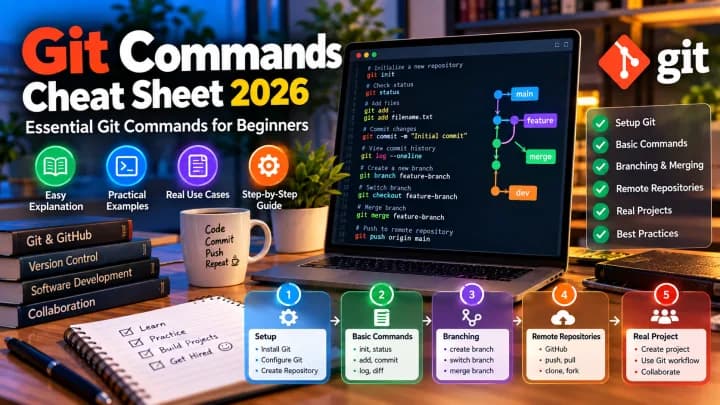
Ignoring Git
Git is a fundamental part of modern software-development workflows.
Learn it early.
Ignoring databases
Most business applications involve data.
Even front-end developers benefit from understanding how APIs and databases fit into an application.
Copying projects without understanding them
A portfolio is useful only when you can explain:
- Why you built the project
- How it works
- What problems you encountered
- How you solved them
- What you would improve
Chasing every new technology
Technology changes constantly.
Programming fundamentals change much more slowly.
Build strong foundations first.
Frequently Asked Questions
Which programming language is best for getting a job in 2026?
There isn't one language that guarantees employment. Python, JavaScript/TypeScript, Java, C#, SQL, Kotlin, C++, and other languages serve different areas of software development. Choose based on the type of role you want.
Is Python enough to get a job?
Knowing Python syntax alone usually isn't enough. Depending on the role, you may also need SQL, Git, APIs, frameworks, testing, deployment, data structures, and project experience.
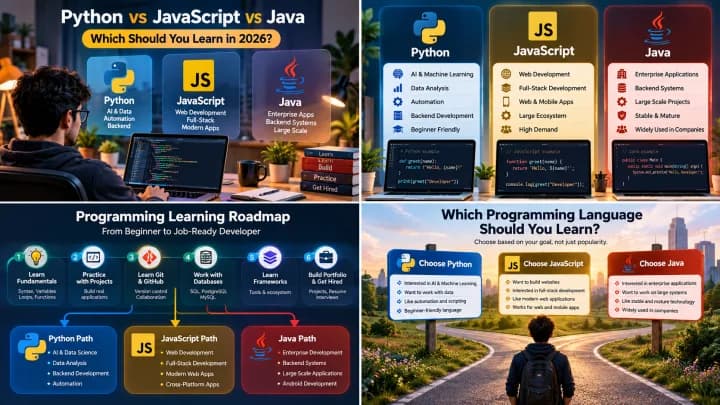
Should I learn Python or JavaScript first?
Choose Python if you're interested in AI, data, automation, or certain backend roles. Choose JavaScript if your primary goal is web development.
Should I learn Java in 2026?
Java remains relevant for enterprise and backend development. If companies and roles you're targeting use Java, it can be a practical language to learn.
Which language should I learn for Android development?
Kotlin is a strong choice for native Android development. For cross-platform mobile development, Flutter and Dart are another path.
How many programming languages should a beginner learn?
Start with one. Learn programming fundamentals and build projects with it before adding another language.
Final Thoughts
The best programming language to learn in 2026 is the one that moves you toward the kind of software-development career you actually want.
If you're still undecided, Python provides an accessible introduction to programming.
For web development, JavaScript and TypeScript are highly relevant.
For enterprise development, Java and C# are worth investigating.
For Android, consider Kotlin. For cross-platform Flutter development, learn Dart. For AI and data work, Python and SQL make a practical combination.
But remember:
Don't build your career around collecting programming languages. Build it around solving problems.
Pick one path, learn its core technologies, build real projects, publish your work, and keep improving.
Comments
0Be the first to leave a comment.