
SEO for Beginners 2026: Complete Step-by-Step Guide to Rank on Google
SEO is still the highest-ROI traffic source available in 2026 — if you understand how it actually works. This complete beginner's guide explains how search engines rank content, the exact on-page and off-page steps, keyword research made simple, and what most beginners do wrong that kills their rankings before they even start.
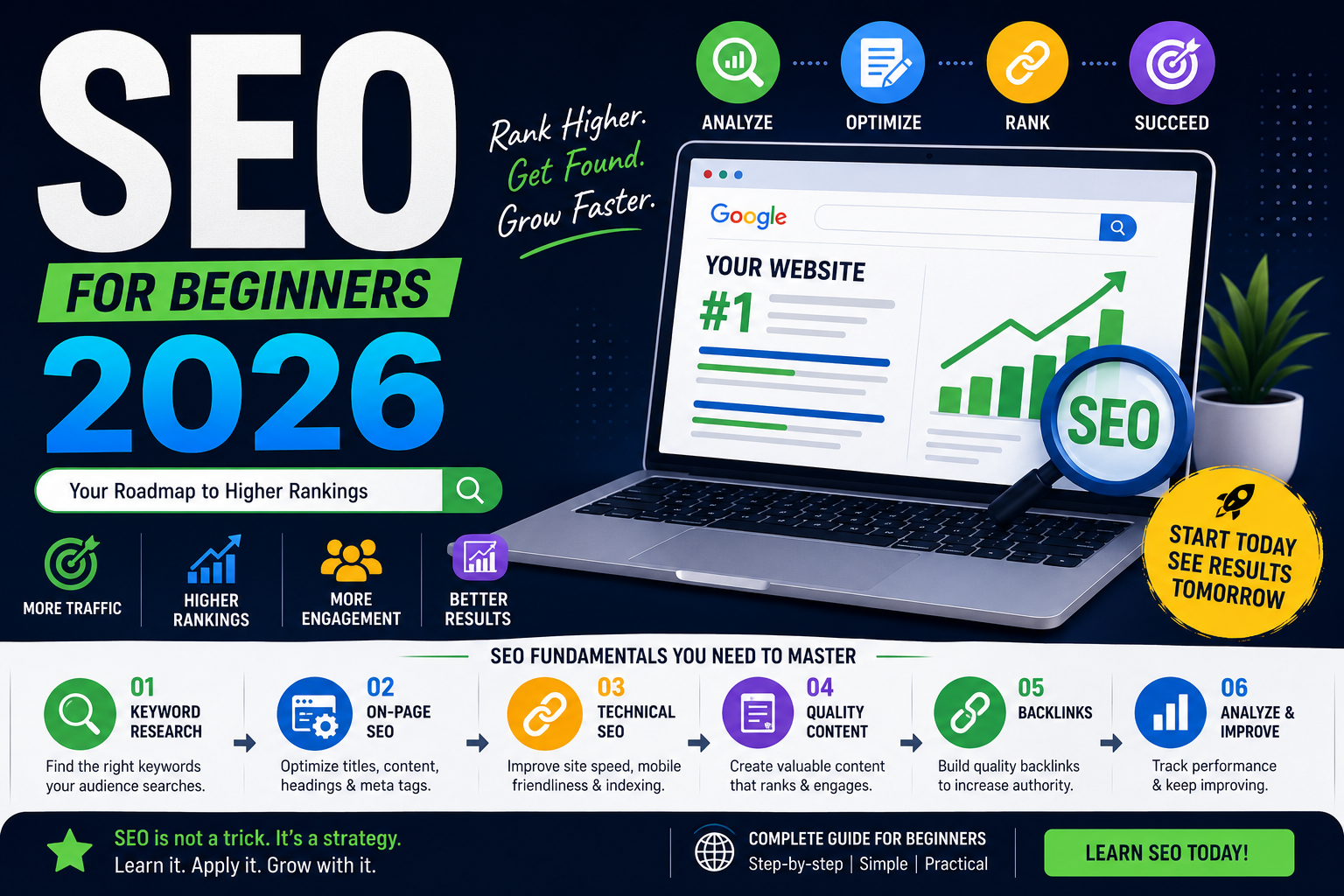
SEO is not magic. It is not a mystery. It is not something that only agencies with expensive retainers can understand. At its core, SEO is a straightforward process: create content that genuinely answers what people are searching for, present it in a way that search engines can read correctly, and build enough credibility over time that Google decides your answer is worth showing at the top.
In 2026, the fundamentals that have always driven SEO success still matter more than any algorithm update or AI-generated shortcut. This guide explains those fundamentals in plain terms — the right order, without the jargon that most SEO content uses to sound more complicated than the subject actually is.
What Is SEO and Why Does It Still Matter in 2026?
SEO stands for Search Engine Optimisation. It is the practice of making your website and content appear higher in the unpaid (organic) results of search engines like Google. When someone searches "best budget smartphones India 2026" and your article appears at the top without you paying for the placement — that is SEO working. You earned that position through the quality and structure of your content.
Why does it still matter in an era of social media, paid ads, and AI-generated content? Because organic search traffic has specific qualities that no other channel matches: it is intent-driven (people are actively looking for exactly what you offer), it is consistent (a well-ranking page sends traffic every day without daily effort), and it compounds over time (content you publish today can generate traffic for years). According to Backlinko's research, the first organic result on Google receives approximately 27.6% of all clicks. The traffic difference between position one and position ten is not incremental — it is enormous.
The Three Pillars of SEO Every Beginner Must Know
Every SEO strategy rests on three pillars. Most beginners focus on one and ignore the others. Sustainable Google rankings require all three working together:
- Technical SEO: The behind-the-scenes setup that makes your website readable and crawlable by search engine bots. Site speed, mobile-friendliness, HTTPS security, correct URL structure, XML sitemap, and robots.txt configuration. If technical SEO is broken, no amount of content or backlinks will fix your rankings.
- On-Page SEO: The optimisation of individual pages to target specific search queries and satisfy what users are actually looking for. Covers your title tags, headings, meta descriptions, content quality, internal links, and image alt text.
- Off-Page SEO: Credibility signals that come from outside your website — primarily backlinks (other websites linking to yours). Google interprets a link from a credible site as a vote of confidence that your content is trustworthy and valuable.
Step 1 — Keyword Research: Find What People Actually Search For
Keyword research is the process of finding the exact words and phrases your target audience types into Google, then creating content that precisely matches what they are looking for. This is where most beginner SEO efforts fail — people write about what they want to write about rather than what their audience is actively searching for.
The most important concept to understand first is search intent — the reason behind a search query. A keyword with 500 monthly searches where the intent exactly matches your content is more valuable than a keyword with 50,000 monthly searches where the intent is misaligned with what you offer. Google is very good at distinguishing between these, and ranking for the wrong intent is nearly impossible no matter how good your content is.
The four types of search intent:
| Intent Type | What the User Wants | Example Search | Best Content Type |
|---|---|---|---|
| Informational | Learn something | "what is SEO" | Blog post, guide, tutorial |
| Navigational | Find a specific website | "Ahrefs login" | Not targetable for most sites |
| Commercial | Research before buying | "best SEO tool 2026" | Comparison article, review |
| Transactional | Buy or take action now | "buy Ahrefs plan" | Landing page, product page |
Free keyword research tools for beginners:
- Google Search itself: Type your topic and study the autocomplete suggestions, the "People Also Ask" boxes, and the "Related Searches" section at the bottom of results. These show you exactly what real users are searching for — straight from Google's own data.
- Google Keyword Planner: Free with a Google Ads account (no spending required). Shows search volume ranges and keyword competition levels.
- Ubersuggest free tier: Three free daily searches showing keyword volume, SEO difficulty score, and competitor analysis.
- AnswerThePublic: Visualises every question people ask around a topic — excellent for finding long-tail content ideas with clear informational intent.
Golden rule for beginners: Target long-tail keywords — phrases of three or more words with lower search volume but more specific intent. "SEO tips" is impossible to rank for as a new website. "SEO tips for food bloggers in India 2026" is genuinely achievable. Start narrow, build authority, then compete for broader terms as your domain grows.
Step 2 — On-Page SEO: Optimise Every Page You Publish
Once you know which keyword you are targeting, on-page SEO is about signalling that clearly to Google — without over-optimising (which Google's algorithms actively penalise). Here are the essential elements for every page you publish:
| Element | What to Do | Character Limit |
|---|---|---|
| Title Tag | Include primary keyword naturally near the start | Under 60 chars |
| Meta Description | Summarise the page, include keyword, add a reason to click | Under 160 chars |
| H1 Heading | One per page, include primary keyword naturally | No strict limit |
| H2/H3 Subheadings | Structure your content, include related keywords naturally | No strict limit |
| URL Slug | Short, keyword-rich, lowercase, hyphens not underscores | Under 75 chars |
| Image Alt Text | Describe the image accurately, include keyword if natural | Under 125 chars |
| Internal Links | Link to 2–4 relevant pages on your own website | Use descriptive anchor text |
| Content Length | Match or exceed the top 3 ranking competitors for that keyword | Check before writing |
One important rule that beginners often miss: keyword density does not matter the way people think it does. Google does not count how many times you use a keyword. It understands the meaning of your content. Use your primary keyword naturally where it fits — in the title, first paragraph, a few headings, and the conclusion — and write the rest of the article for your reader, not for a keyword percentage target.
Step 3 — Technical SEO: Make Sure Google Can Read Your Website
Technical SEO does not require being a developer. The most impactful improvements are straightforward to implement, especially on WordPress with Rank Math or Yoast SEO:
- Page speed: Google uses page speed as a direct ranking factor for both desktop and mobile results. Test your site free at PageSpeed Insights. Compressing images with a free plugin like ShortPixel or Smush is almost always the highest-impact first fix.
- Mobile-friendliness: Over 60% of Google searches in India happen on mobile devices. Google's mobile-first indexing means it primarily crawls and indexes the mobile version of your site. Test it at Google's Mobile-Friendly Test.
- HTTPS: Your website must have a valid SSL certificate — the padlock visible in the browser address bar. Google flags HTTP sites as "Not Secure" in Chrome and ranks them below HTTPS equivalents. Most hosting providers include free SSL via Let's Encrypt.
- XML Sitemap: A file that lists all your pages and helps Google discover and index your content faster. SEO plugins like Rank Math generate this automatically. Submit it to Google Search Console once and it stays updated automatically.
- Core Web Vitals: Google's set of user experience metrics — Largest Contentful Paint (LCP), Cumulative Layout Shift (CLS), and Interaction to Next Paint (INP). Your PageSpeed Insights report shows your scores for each. Focus on LCP and CLS first as they have the most impact on rankings.
Step 4 — Building Backlinks: Earning Authority from Other Websites
Backlinks remain the most powerful off-page ranking signal in 2026. A backlink is a hyperlink on another website pointing to yours — Google treats it as a vote of confidence that your content is credible enough to recommend. The quality of backlinks matters far more than the quantity. One link from a relevant, high-authority website in your niche is worth more than 100 links from random, irrelevant sites.
Beginner-friendly link building strategies that actually work:
- Create genuinely linkable content. Original research, comprehensive guides, free tools, unique data, and definitive how-to articles attract natural links from writers who reference your work. This is the most sustainable long-term strategy.
- Guest posting. Write a helpful, original article for another blog in your niche that includes a relevant link back to your site. Focus on quality sites in your topic area with real audiences — not generic guest post directories.
- Broken link building. Find broken links on other websites in your niche and reach out to suggest your content as a working replacement. Browser extensions like Check My Links make finding them quick.
- Get listed in directories. For Indian businesses, listings in Google Business Profile, Justdial, Sulekha, and niche-specific directories count as citations that build local SEO authority.
What not to do: Never buy backlinks, never participate in private blog network (PBN) schemes, and never build links from irrelevant sites just to inflate your count. Google's Penguin algorithm identifies unnatural link patterns and can penalise your site severely — in some cases removing it from search results entirely.
Free SEO Tools Every Beginner Should Use in 2026
| Tool | What It Does | Cost |
|---|---|---|
| Google Search Console | Shows how Google sees your site, which keywords send traffic, index issues | Free forever |
| Google Analytics 4 | Tracks visitors, behaviour, traffic sources, conversions | Free forever |
| Google PageSpeed Insights | Tests page speed and gives specific actionable fixes | Free forever |
| Ubersuggest (free tier) | Keyword research, competitor analysis, backlink data | Free (3/day) |
| Rank Math (WordPress) | On-page SEO scoring, sitemap, schema markup, redirects | Free plugin |
| AnswerThePublic (free) | Finds questions people ask around any topic | Free (limited) |
How Long Does SEO Take to Work in 2026?
This is the question beginners ask most — and the honest answer is: longer than most people want, but shorter than most give up at. A brand new website in a competitive niche typically takes three to six months to see meaningful organic traffic. A site targeting long-tail keywords in a less competitive niche, with consistent quality publishing, can see first page rankings in four to eight weeks.
The websites that give up at month two are the ones that would have ranked at month four. The single biggest predictor of SEO success is not technical knowledge or budget — it is the willingness to publish consistently excellent content over a period of months without seeing immediate results.
The right mindset: Publish one thoroughly researched, properly optimised, genuinely useful piece of content every week. Do not publish five average pieces. Depth, originality, and genuine helpfulness are what Google rewards in 2026 — not volume.
SEO Mistakes Beginners Make That Kill Rankings
- Targeting keywords that are too competitive too early. A new website cannot rank for "best smartphones India." Start with "best budget 5G smartphone under ₹15,000 for students India 2026" — then expand.
- Publishing thin content. Articles under 500 words that do not fully answer the search query rank poorly in 2026. Match the depth of what is already ranking.
- Ignoring internal linking. Linking between your own articles passes authority between pages and helps Google understand your site structure. Every new article should link to two or three existing ones.
- Not updating old content. Google favours freshness. Articles published two years ago that are not updated gradually lose rankings to newer, more current content. Set a reminder to review and update your top pages every six months.
- Publishing AI content without editing. Google's 2025 Helpful Content updates specifically targeted low-quality AI-generated content that provides no original insight. AI is a useful drafting tool — but every article must include original perspective, verified facts, and human editing before it goes live.
Frequently Asked Questions
Is SEO free in 2026?
The techniques of SEO are completely free — keyword research, on-page optimisation, content creation, and earning backlinks cost nothing except time. Google Search Console, Google Analytics, and the free tiers of Ubersuggest and Rank Math are sufficient for beginners to make meaningful progress without spending anything on paid tools.
Does SEO still work with AI search changing how Google works?
Yes, but the approach has matured. Google's AI Overviews (featured summaries at the top of results) have reduced clicks for some simple informational queries. However, detailed guides, product comparisons, local searches, and transactional queries still send significant organic traffic to websites. The solution is creating content with original research, genuine expertise, and depth that AI-generated summaries cannot replicate.
How many articles do I need before SEO starts working?
There is no magic number, but most experienced SEO practitioners recommend publishing at least 20 to 30 high-quality, keyword-targeted articles before expecting meaningful organic traffic. Building topical authority — covering a subject area comprehensively across multiple related articles — consistently produces faster results than publishing isolated pieces on unrelated topics.
What is the most important SEO ranking factor in 2026?
Content quality and relevance remain the most important ranking factors — specifically whether your content fully satisfies the search intent behind a query. Backlinks from credible websites in your niche are the second most important factor. Technical SEO is the foundation that allows the other two to work — without it, excellent content and strong backlinks still may not rank.
Should I use AI to write SEO content in 2026?
AI tools like ChatGPT are useful for drafting outlines, generating first drafts, and suggesting related topics. However, publishing AI content without significant human editing, original research, and personal perspective is a risk in 2026 — Google actively identifies and downgrades content that provides no value beyond what AI can generate. Use AI to speed up your process, not to replace your thinking.
Sources: Backlinko — Google CTR Research | Google Search Central Documentation | Rank Math SEO Basics | Moz — Beginner's Guide to SEO | Ahrefs — SEO Basics Guide


Comments
0Be the first to leave a comment.