
Social Media Marketing for Beginners 2026: Complete Step-by-Step Strategy Guide
5.2 billion people use social media in 2026. Social platforms now drive over 60% of product discovery — more than Google. If your business is not on social media with a real strategy, you are invisible to the majority of your potential customers. This complete beginner's guide shows you exactly where to start, what to post, and how to measure results.
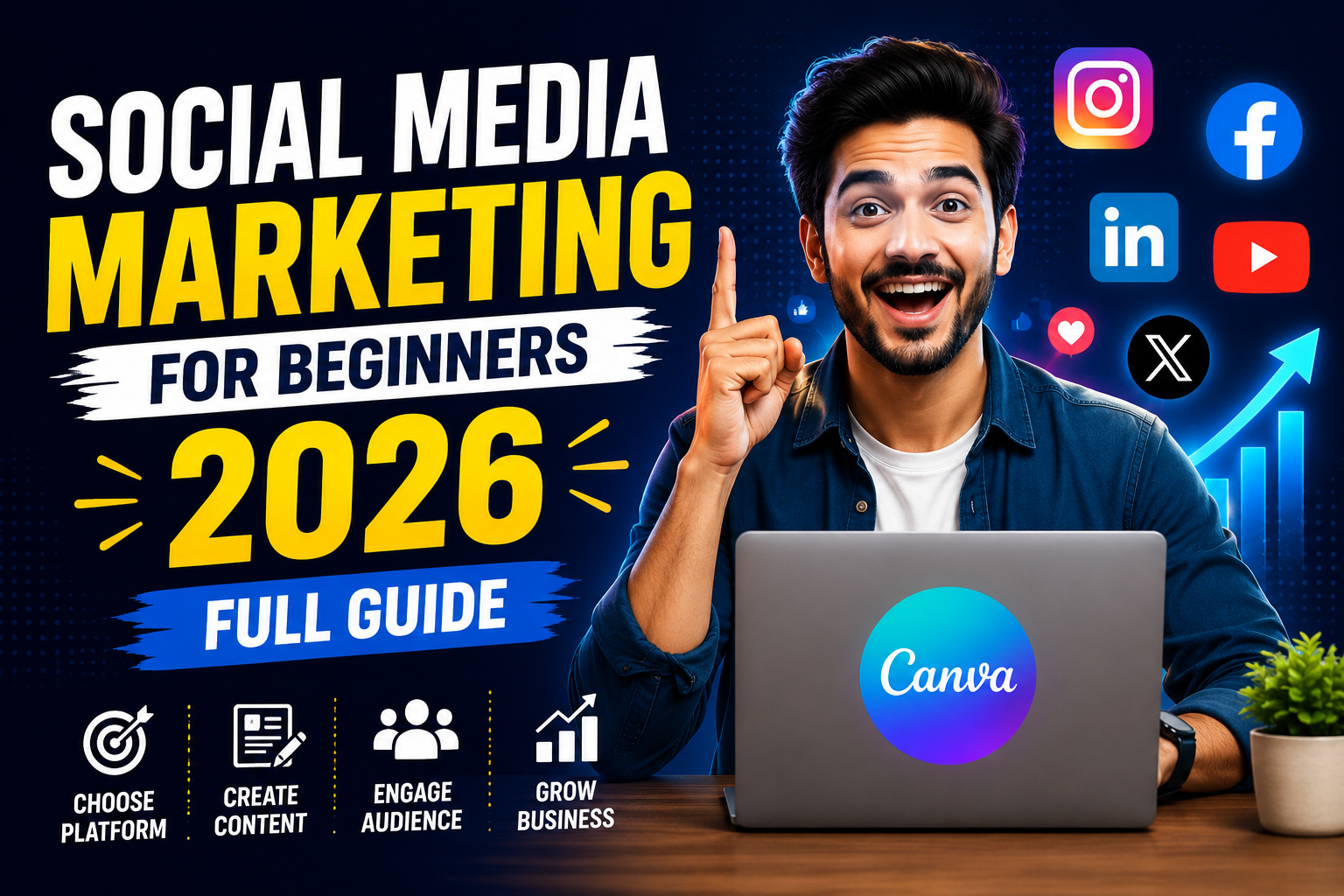
The most important shift in digital marketing in 2026 is not AI, not paid ads, and not SEO — it is the fact that social media platforms have become the new search engines. According to Sprout Social's 2026 data, platforms like YouTube, TikTok, and Instagram collectively drive over 60% of product discovery, while Google now accounts for just 34.5% of total search share. Your potential customers are finding products, comparing options, and making purchase decisions without ever opening a search engine. If your business has no credible social media presence, you are invisible to the majority of your market.
This guide gives you the complete framework for getting started with social media marketing in 2026 — what it actually means, which platforms to prioritise, what to post, how often, and how to know whether any of it is working.
The 2026 Social Media Landscape: Numbers You Must Know
| Platform | Monthly Active Users (2026) | Best For | Avg Engagement Rate |
|---|---|---|---|
| 3.1 billion | Community, ads, local business | 0.07% – 0.15% | |
| YouTube | 2.9 billion | Long-form video, tutorials, Shorts | High (video-dependent) |
| 2.8 billion | Direct customer communication, India | Near 100% open rate | |
| 2.3 billion | Visual brands, Reels, shopping | 0.50% – 1.0% | |
| TikTok | 1.6 billion | Short-form video, Gen Z, discovery | 5.69% ⭐ (highest) |
| 1+ billion (200M in India) | B2B, professional content, careers | 2% – 5% | |
| 500 million+ | Visual discovery, blog traffic, shopping | 0.30% – 1.50% | |
| X (Twitter) | 400 million+ | Real-time news, thought leadership | Low but fast-moving |
For Indian businesses specifically, the numbers are even more compelling. India alone is projected to generate over ₹2 lakh crore in social commerce revenue in 2026 — purchases made directly through social platforms. WhatsApp Business is used by millions of Indian small businesses as a primary sales channel. Instagram Reels and YouTube Shorts are the dominant discovery formats for Indian consumers under 35. LinkedIn has nearly 200 million Indian members, making it the world's largest LinkedIn audience outside the United States.
Step 1 — Define Clear Goals Before You Post a Single Thing
The most common social media mistake businesses make is starting with content before defining what they actually want social media to achieve. Random posting produces random results. Before creating a single post, write down answers to these three questions:
- What is the goal? Brand awareness, website traffic, leads, direct sales, customer service, community building, or recruiting — these require completely different strategies. Pick one primary goal for the first 90 days.
- Who is the specific audience? Not "everyone who might like my product" — a specific person. Age range, location, income level, interests, problems they are trying to solve. The more precisely you can describe your target customer, the more effectively your content can reach them.
- How will you measure success? Followers are a vanity metric. Define a real number: website clicks per month, leads generated, messages received, or direct sales traced to social media.
According to Hootsuite's 2026 strategy report, 25% of marketers cite measuring ROI as their top social media challenge — precisely because most of them did not define measurable goals before they started. Starting with clear, specific goals fixes this problem before it begins.
Step 2 — Choose the Right Platforms (Not All of Them)
The most expensive mistake in social media marketing is trying to be active on every platform simultaneously. You dilute your effort, produce mediocre content everywhere, and build meaningful traction nowhere. The right approach for a beginner is to master one platform first, then expand.
| Your Business Type | Start With | Why |
|---|---|---|
| Visual product (food, fashion, beauty) | 2.3B users, shopping features, Reels for discovery | |
| B2B service or professional brand | Decision-makers, professional credibility, 200M Indian users | |
| Local business or community service | Local groups, events, Facebook marketplace, ads | |
| Education, tutorials, expertise | YouTube | 2.9B users, evergreen content, SEO value |
| Gen Z or youth-focused brand | Instagram Reels / YouTube Shorts | 5.69% TikTok engagement, Reels reach non-followers |
| Blog traffic and visual content | Drives sustained website traffic, high purchase intent | |
| Direct customer sales (India) | WhatsApp Business | Near-100% open rate, UPI integration, trust factor |
Step 3 — Understand the Content Formats That Work in 2026
Not all content performs equally. The data in 2026 is clear about what earns attention and what gets scrolled past:
- Short-form video (Reels, Shorts, TikTok): Delivers the highest ROI of any content format — 41% of marketers cite it as their top-performing format. Instagram Reels generate 22% more interactions than regular video posts. YouTube Shorts receive over 70 billion views per day. If you are only going to invest in one content type as a beginner, make it short-form video.
- Carousels (multi-slide posts): The highest-saving and highest-sharing format on Instagram for educational content. A well-structured carousel that teaches something useful in 8 to 10 slides consistently outperforms single static images on reach.
- Human-generated content: Sprout Social's 2026 data identifies human-generated content as the #1 priority for social media users this year. Real faces, real voices, real opinions outperform polished brand content consistently across every platform. Showing your face — even briefly — dramatically increases trust and engagement.
- Static images and graphics: Still valuable for product showcases, quotes, infographics, and announcements — but significantly outperformed by video when reach is the goal.
- Text-based posts: Perform well on LinkedIn (where articles and long-form posts reach professional audiences) and X (where text threads still generate significant engagement for news and opinion content).
Step 4 — Build a Simple Content Calendar
Consistency is the single most predictable variable in social media growth. An account that posts three times a week without fail, every week, for six months, will almost always outperform one that posts daily for three weeks and then goes silent for a month. The goal is a posting schedule you can maintain indefinitely — not a schedule that looks impressive for two weeks.
A realistic beginner's posting schedule for one platform:
| Platform | Recommended Frequency | Best Posting Times (India) |
|---|---|---|
| 3–5 posts/week (1–2 Reels minimum) | 7–9 AM, 12–2 PM, 7–9 PM IST | |
| 3–5 posts/week | 8–10 AM, 6–8 PM IST | |
| 2–3 posts/week | 8–10 AM weekdays IST | |
| YouTube | 1 video/week + 2–3 Shorts | 2–4 PM, 7–9 PM IST |
| 5–10 pins/day | Evenings and weekends IST | |
| Twitter/X | 1–3 tweets/day | 8–10 AM, 12–1 PM IST |
Use Buffer's free plan to schedule posts across platforms in advance. Spend one hour on Monday planning and scheduling the week's content — then the daily task of posting disappears entirely.
Step 5 — Engagement Is More Important Than Publishing
Most beginners treat social media as a broadcast channel — they publish content and wait for results. The data tells a different story. The 2026 State of Social Media Engagement Report found that the biggest driver of post performance is not when or how you post — it is whether you show up and respond to your audience. Accounts that reply to comments consistently see engagement increase by up to 42% on some platforms. 73% of consumers say they will switch to a competitor if a brand does not respond to them on social media.
The practical implications:
- Reply to every comment on your posts within 24 hours — especially in the first hour after publishing, when platform algorithms weigh early engagement most heavily
- Respond to every DM, even if just with a brief acknowledgment
- Engage with content from accounts in your niche — leave genuine, substantive comments on other people's posts rather than just liking them
- Use questions, polls, and "save this post" calls to action in your captions to invite participation rather than just passive viewing
Step 6 — Use Micro-Influencers Instead of Celebrities
If budget allows for influencer partnerships, the data in 2026 overwhelmingly favours micro-influencers — accounts with 10,000 to 100,000 followers — over celebrity or macro-influencer accounts. According to Sociolabs' 2026 guide, micro-influencers consistently outperform macro-influencers in both engagement rates and actual conversion to sales. Their audiences are more niche, more trusting, and more likely to act on recommendations. They also charge a fraction of what larger accounts command — Indian micro-influencers typically charge ₹3,000 to ₹15,000 per post compared to lakhs for celebrity accounts.
94% of organisations report that influencer marketing outperforms traditional digital advertising, often delivering two to three times the return on ad spend. For a small Indian business with a limited marketing budget, one well-chosen micro-influencer in your specific niche will consistently outperform a large generic advertising campaign.
Step 7 — Measure What Matters, Ignore What Does Not
Follower count is the most watched and least meaningful social media metric. Focus on these instead:
| Metric | What It Tells You | Where to Find It |
|---|---|---|
| Reach | How many unique accounts saw your content | Platform native analytics |
| Engagement Rate | % of viewers who interacted (likes, comments, shares, saves) | Platform analytics |
| Website Clicks | How many people clicked through to your website | Google Analytics 4 (UTM links) |
| Saves (Instagram) | Content people found valuable enough to revisit | Instagram Insights |
| Profile Visits | Content that drove enough curiosity to explore your account | Platform analytics |
| Leads / DMs | Potential customers who reached out directly | Your inbox |
| Direct Sales | Revenue traced back to social (UTM tracking) | Google Analytics 4 |
Review your platform analytics every two weeks. Identify your top three performing posts in terms of reach and engagement. Look for patterns — which topics resonated? Which formats worked? Double down on what the data shows is working rather than continuing to post what you personally find interesting.
Common Social Media Mistakes Beginners Make in 2026
- Promoting before building trust. A new account that posts only sales content from day one builds zero audience. The 80/20 rule works: 80% value-giving content (education, entertainment, inspiration) and 20% promotional content.
- Ignoring comments and DMs. Every unanswered comment is a missed relationship. Every ignored DM is a missed sale.
- Copying competitor content instead of finding a distinct voice. Audiences follow accounts because of a unique perspective. Replicating what others do just adds noise to an already crowded space.
- Chasing follower count instead of engagement. 1,000 genuinely engaged followers who trust your account are worth more to any business than 50,000 passive followers who never interact.
- Quitting after 30 days without results. Social media compounds over time. Most accounts see the biggest growth between months three and six. The ones that quit at month one never see it.
Frequently Asked Questions
Which social media platform is best for beginners in 2026?
Instagram is the most balanced starting platform for most beginners in 2026 — it has 2.3 billion users, built-in shopping features, strong Reels reach to non-followers, and well-documented best practices. For B2B businesses, LinkedIn is a stronger starting point. For local Indian businesses, WhatsApp Business combined with Facebook covers the most practical ground fastest.
How often should I post on social media in 2026?
Consistency matters more than frequency. Three to five posts per week on one platform, maintained reliably for six months, outperforms daily posting for two weeks followed by a month of silence. Choose a schedule you can genuinely sustain before worrying about volume. Use Buffer's free plan to schedule posts in advance so daily publishing does not require daily effort.
Does social media marketing actually work for small businesses in India?
Yes — significantly. India is projected to generate ₹2 lakh crore in social commerce revenue in 2026. WhatsApp Business, Instagram Reels, and YouTube Shorts are driving real sales for small Indian businesses across every category — food, fashion, education, home services, and digital products. The gap between businesses with a real social strategy and those without is widening every year.
How long does social media marketing take to show results?
Organic social media typically shows meaningful results in three to six months of consistent effort. Paid social advertising can show results in days but requires budget and ongoing optimisation. The businesses that see the strongest long-term results combine both: organic content builds trust and community, while occasional paid promotion accelerates reach during product launches or key moments.
Is it better to focus on organic or paid social media marketing?
Start organic — build genuine content, understand what your audience responds to, and establish a real posting habit before spending money on ads. Paid social amplifies what already works organically; it rarely rescues content that is not performing without promotion. Once you have identified your best-performing content types and have at least one post that earns high organic engagement, that is the content to put paid budget behind.
Sources: Sprout Social — Social Media Statistics 2026 | Hootsuite — Social Media Strategy 2026 | Buffer — Complete Social Media Marketing Guide | Socioapt — SMM Statistics 2026 | Sociolabs — SMM Guide India 2026
Comments
0Be the first to leave a comment.