
Will AI Replace Jobs in India? The Honest Truth Every Professional Must Know in 2026
AI will transform 38 million jobs in India by 2030. But the World Economic Forum says it will create 97 million new roles while displacing 85 million. The real question is not whether AI will change your job — it already is. The question is whether you are on the right side of that change.
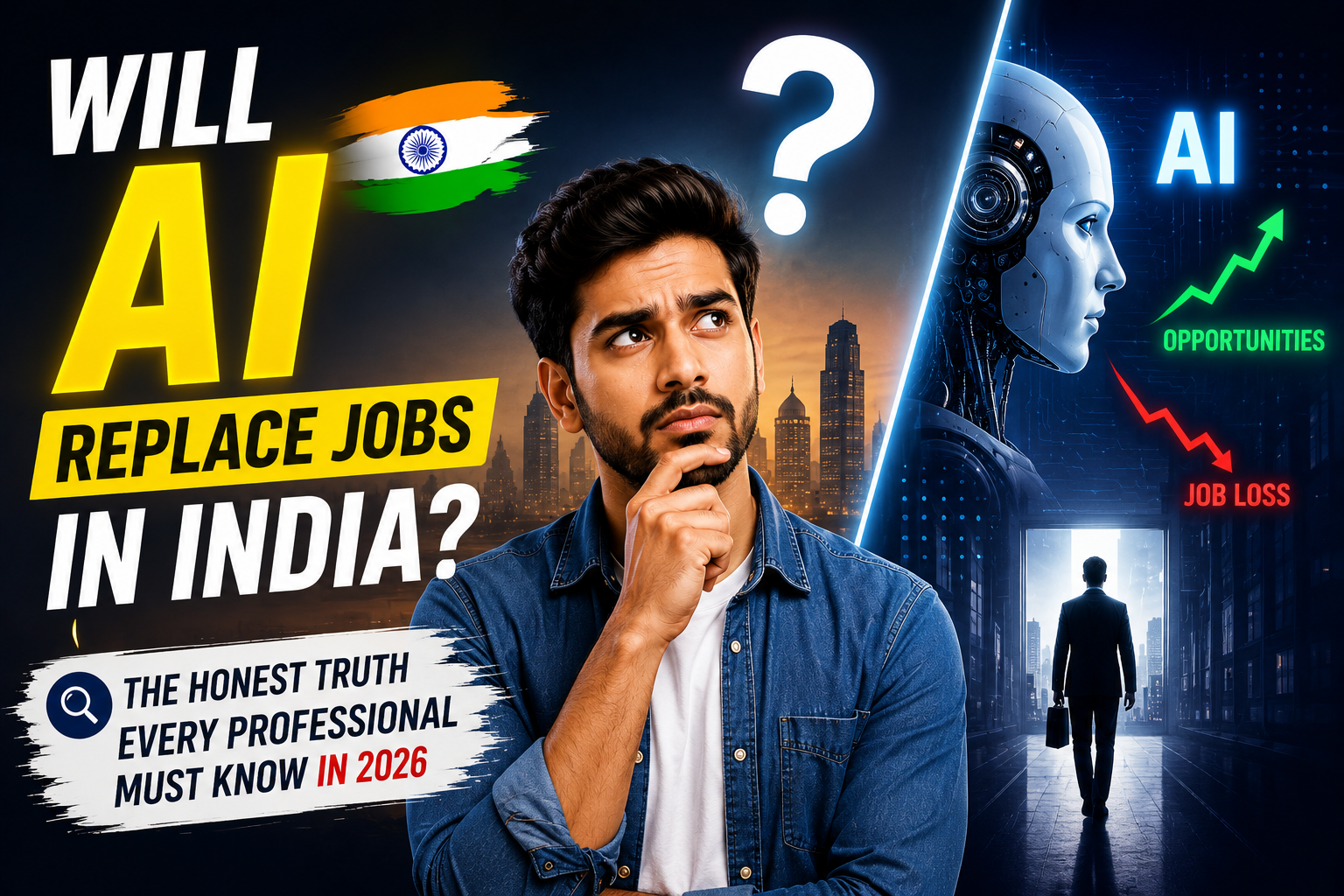
The question that every working professional in India is asking in 2026 — whether out loud or quietly — is the same one: Is AI coming for my job? The honest answer is more nuanced than the fear or the optimism you will find on social media. AI is not going to replace all jobs. But it is absolutely going to replace some jobs, transform most jobs, and create entirely new categories of work that did not exist five years ago.
Understanding which side of that equation you are on — and what to do about it — is the most important career decision an Indian professional can make right now.
The Real Numbers: What the Data Says About India
Rather than speculation, here is what the research actually shows in 2026:
| Source | Finding |
|---|---|
| Ernst & Young | 38 million jobs in India will be transformed by generative AI by 2030 |
| World Economic Forum | AI will displace 85 million jobs globally but create 97 million new roles |
| IMF | 47% of jobs in emerging markets like India are exposed to AI automation |
| Indian Industry Data | 2.9 lakh AI-based jobs existed in India in 2025 — demand growing 32% in 2026 |
| E&Y India Report | 24% of tasks in India are fully automatable; 42% can be AI-enhanced |
| LinkedIn 2026 | Fastest-growing careers are human-centric: therapy, HR, senior management |
| AI Engineer Job Data | Demand for AI Engineers grew 143.2% year-over-year as of 2025 |
The critical word in the Ernst & Young figure is transformed — not eliminated. According to Jetking's 2026 analysis of the E&Y report, 24% of tasks across Indian industries are deemed fully automatable, while another 42% are primed for AI enhancement. These are tasks within jobs — not entire jobs disappearing overnight. The result is that most roles in India are changing in what they require, rather than disappearing entirely.
Jobs Most at Risk in India Right Now
Being honest about which roles face the highest displacement risk is more useful than false reassurance. The jobs that AI is already actively replacing — not theoretically threatening — fall into a clear pattern: they are roles dominated by repetitive, rule-based, high-volume tasks where the decision-making follows a predictable structure.
| Job Category | What AI Is Replacing | Risk Level |
|---|---|---|
| Data Entry | Manual data extraction, form filling, database updates | 🔴 Very High |
| Basic Customer Support | FAQ responses, order tracking, complaint logging | 🔴 Very High |
| Call Centre Agents | Scripted sales calls, basic query resolution | 🔴 High |
| Junior Copywriters | Generic product descriptions, basic ad copy | 🟡 Medium-High |
| Basic Accounting | Routine bookkeeping, invoice processing, payroll | 🟡 Medium-High |
| Junior Data Analysts | Standard reporting, basic dashboards, data cleaning | 🟡 Medium |
| Entry-Level Coding | Boilerplate code, simple debugging, documentation | 🟡 Medium |
| Translation (routine) | Standard document translation between common languages | 🟡 Medium |
India's IT sector deserves specific attention here. Approximately 5 million Indians work in IT services, many in roles involving repetitive coding tasks, basic testing, and documentation — exactly the tasks that AI coding assistants like GitHub Copilot and Claude Code are now handling faster and more accurately than junior developers. This is not speculation — it is already reflected in hiring slowdowns for entry-level IT roles at large Indian IT services companies in 2025 and 2026.
Jobs That Are Safe from AI — And Why
The World Economic Forum's data and LinkedIn's 2026 "Jobs on the Rise" report both point to the same surprising conclusion: the fastest-growing careers in 2026 are not technical ones — they are deeply human ones. Roles in behavioural therapy, strategic human resources, and senior management are seeing record demand precisely because AI cannot replicate what makes them valuable.
The pattern is clear: any job that requires genuine human connection, complex ethical judgement, physical dexterity in unpredictable environments, or high-level creative direction is structurally protected from AI replacement — not because AI cannot simulate these things, but because humans will not accept AI substitutes for them.
| Job Category | Why AI Cannot Replace It | Safety Level |
|---|---|---|
| Mental health counsellors | Genuine therapeutic relationship, trust, human empathy | 🟢 Very Safe |
| Teachers (mentoring role) | Motivation, emotional intelligence, student understanding | 🟢 Very Safe |
| Surgeons and doctors | Complex diagnosis, physical procedure, ethical accountability | 🟢 Very Safe |
| Senior business strategists | Ambiguous decisions, stakeholder management, vision | 🟢 Very Safe |
| Skilled tradespeople | Physical dexterity in unpredictable settings | 🟢 Very Safe |
| Creative directors | Originality, cultural intuition, editorial judgement | 🟢 Safe |
| Social workers | Complex human situations, crisis response, advocacy | 🟢 Safe |
| Lawyers (senior level) | Courtroom advocacy, complex legal strategy, client trust | 🟢 Safe |
New Jobs AI Is Creating in India
The most important but least-discussed part of the AI jobs conversation is what is being created. India had 2.9 lakh AI-based jobs in 2025 — and that number is growing at 32% annually in 2026. Demand for AI Engineers specifically grew 143.2% year-over-year, making it one of the fastest-growing job titles in human history. These are not theoretical future roles — they are available right now, paying premium salaries, to candidates with the right skills.
| New AI Job Role | What They Do | India Salary Range (2026) |
|---|---|---|
| AI Engineer | Build, deploy, and maintain AI systems | ₹12L – ₹45L per annum |
| Prompt Engineer | Design effective AI prompts for business workflows | ₹8L – ₹25L per annum |
| Machine Learning Engineer | Train and optimise ML models for production | ₹15L – ₹50L per annum |
| AI Product Manager | Manage AI-powered product development | ₹18L – ₹45L per annum |
| AI Ethics Officer | Ensure AI systems are fair, safe, and compliant | ₹12L – ₹30L per annum |
| AI Data Trainer | Label, curate, and quality-check training data | ₹4L – ₹12L per annum |
| AI Integration Specialist | Integrate AI tools into existing business workflows | ₹10L – ₹28L per annum |
The Real Dividing Line: AI Users vs Non-AI Users
The most important insight from 2026's job market is not that AI is replacing humans — it is that humans who use AI are replacing humans who do not. This is the actual mechanism of disruption that most coverage misses. A developer using AI coding tools produces three to four times the output of one who does not, meaning one AI-assisted developer can replace three non-AI-assisted developers for the same cost. A content writer who uses ChatGPT intelligently produces more in two hours than one who does not uses in a day.
As Growth India's 2026 workforce analysis puts it: the defining reality of 2026 is not job loss — it is the evolution of work. The major economic divide is between professionals who use AI effectively and those who do not. That divide is widening faster than any other skills gap in India's professional history.
What Indian Professionals Must Do Right Now
The practical response to the AI jobs shift is not panic — it is structured upskilling. Here is what actually matters in 2026 for different professional groups:
- IT professionals: Move beyond writing code to understanding system design, AI integration, and cloud architecture. The demand for developers who can build with AI is growing faster than demand for developers who can write everything from scratch.
- Content writers: The demand for basic content writing is declining. The demand for writers who can direct AI output, provide original research, and bring genuine expertise to a topic is growing. Specialise in a niche — health, finance, law, technology — where expertise cannot be replicated by a generic prompt.
- Customer service professionals: Move toward roles that require complex empathy, escalation handling, and relationship management. Basic query resolution is being automated; high-stakes customer relationships are not.
- Teachers and trainers: The content delivery part of education is under pressure from AI. The mentoring, motivation, and emotional intelligence part is not. Lean into what makes a great teacher human.
- Everyone: Develop AI literacy — not coding, but practical competence in using AI tools relevant to your profession. The formula is straightforward: your current skill + AI literacy = significantly more valuable in 2026's job market.
The Honest Bottom Line
AI is not going to eliminate the Indian workforce. It is going to eliminate specific tasks, compress specific roles, and raise the bar for what makes a professional valuable. According to the World Economic Forum's latest data, AI is expected to create a net gain of 78 million jobs globally by 2030 — 170 million new roles created against 92 million displaced. The Indian economy, with its young workforce and rapidly expanding digital infrastructure, is positioned to benefit from this shift — but only for those who adapt.
The professionals who will thrive in India's AI era are not necessarily the most technically skilled — they are the most adaptable. Those who treat AI as a colleague rather than a competitor, who use it to amplify what they are already good at rather than resist it out of fear, will find that 2026 offers more career opportunity than any point in the last decade. The question is simply whether you are willing to learn.
Frequently Asked Questions
Will AI replace software engineers in India?
Not entirely, but the nature of software engineering work is changing significantly. AI coding tools are automating boilerplate code generation and basic debugging. Engineers who focus on system architecture, AI integration, and complex problem solving are not at risk — in fact, demand for these skills is growing rapidly. Entry-level coding roles that primarily involve repetitive tasks face the highest risk of reduction.
Which jobs in India are safest from AI in 2026?
Jobs requiring genuine human connection, complex ethical decisions, physical dexterity in unpredictable environments, and high-level creativity are the safest. This includes mental health counsellors, surgeons, senior business strategists, skilled tradespeople, and social workers. According to LinkedIn's 2026 "Jobs on the Rise" report, these human-centric roles are seeing record demand.
How many AI jobs are available in India in 2026?
India had approximately 2.9 lakh AI-based job openings in 2025, with demand growing at 32% annually in 2026. AI Engineer roles specifically saw 143.2% year-over-year demand growth. Salaries for AI engineers in India range from ₹12 lakh to ₹45 lakh per annum depending on experience and specialisation.
What skills should I learn to be AI-proof in India?
The most important skill is AI literacy — practical competence in using AI tools relevant to your profession. Beyond that: complex problem solving, emotional intelligence, domain expertise in a specific field, and the ability to direct and evaluate AI output rather than only produce manually. The combination of your existing professional skills plus AI literacy is the most effective protection against displacement in 2026.
Is AI creating more jobs than it is destroying in India?
According to the World Economic Forum, AI is expected to create 97 million new global roles while displacing 85 million — a net gain of 12 million. For India specifically, Ernst & Young's research indicates that while 38 million jobs will be transformed by 2030, the country's young, English-speaking, technically-oriented workforce is well-positioned to transition into the new roles AI is creating, provided upskilling happens at sufficient scale and speed.
Sources: Jetking — AI Jobs India 2030 | Growth India — AI Jobs 2026 | DataRefs — AI Job Replacement Statistics | Futurense — Will AI Replace Jobs India | Boterview — AI Replacing Jobs Statistics 2026

Comments
0Be the first to leave a comment.